Showing posts with label News. Show all posts

Hard time for dowry seekers and givers: Dharmadhikari Panel

Declare details of dowry before marriage:  CS Dharmadhikari panel

The panel has recommended that dowry details should be declared by the parties to marriage before registration of marriage.

If the state government accepts the recommendation given by the CS Dharmadhikari committee, then couples will have to give a declaration at the time of their marriage registration about the dowry (if given) and the articles exchanged between them.

This is to ensure that dowry harassment cases are tackled.
The government-appointed committee has given its recommendation/suggestion to prevent crime against woman in its fourth and fifth interim reports. The reports have been submitted to the state and their copies were handed over to the Bombay high court on Monday. It was also informed that the government has extended the term of the committee till November 30.
The committee also has suggested that there has to be a ban on caste panchayats as women are targeted the most there. It says that the police machinery should take action against such panchayats under the Indian Penal Code. It is also said that a complete ban on dance bars has to be imposed as women are depicted in a bad manner in such places.
Social networking websites should be checked for obscene material which is easily available on them. It is stated that divorce rates are going up because of these websites and even people are getting more aggressive due to easy accessibility to information.
The reports were submitted to the court during the hearing of a Public Interest Litigation filed by NGO Help Mumbai Foundation, highlighting the increase in crime against women and lack of measures being adopted by the state to tackle them.
Appearing for the NGO, advocate Rajiv Chavan argued that the government has not yet taken any decision on whether to accept or reject the suggestions given by the committee and the Action Taken Report of the first two interim reports are unclear on several subjects.
Accordingly, the court has directed the state to file an Action Taken Report by October 8 and posted the hearing of the PIL to October 10.
The committee also has suggested that there has to be a ban on caste panchayats as women are targeted the most there. It says that the police machinery should take action against such panchayats under the Indian Penal Code. It is also said that a complete ban on dance bars has to be imposed as women are depicted in a bad manner in such places.
Source: DNA
Read More...

Supreme Court says caste-free India is a mirage

Expressing shock at incidents such as the 2010 Mirchipur riots, the Supreme Court said that the end of caste system in India remained a mirage, while the idea of people of all castes and religion living happily together was only confined to discourses.

On April 21, 2010, Dalit settlements were targeted and torched in Mirchpur village by members of the upper caste. A 70-year-old Tara Chand was killed along with his physically challenged daughter and around 100 other villagers were forced to flee their homes.

"We are sorry to hear about such incidents. Ideally all castes should be living together. But that is only a pravachan (discourse) now... the reality is something else," a bench headed by justice S.J. Mukhopadhyaya said while hearing a petition relating to the rehabilitation of the riot victims. "Caste barrages should be removed. We can rehabilitate them but what is the point of living in fear at all time with four policemen near you for protection," the bench questioned.

A joint inspection ordered by the apex court found that victims were not ready to go back to their village, and should, therefore, be resettled where they don't face caste discrimination. The bench asked the victims' lawyer Colin Gonsalves and the Haryana government to identify suitable land within two weeks.

On September 25, 2011, three persons were sentenced to life, 10 were awarded a fiveyear jail term for participating in the 2010 riots.


Source: India Today
Read More...

Supreme Court Will Examine List of Visitors to CBI Chief's Home

A record of visitors at the home of the CBI chief is packed with "explosive information", the Supreme Court was told today, prompting judges to allow the list to be submitted for their review.

The people who made house calls to CBI Director Ranjit Sinha include those being investigated for the telecom and coal scams, alleged Prashant Bhushan, the lawyer-activist who is also a senior leader of the Aam Aadmi Party.


Mr Sinha's lawyer said in court today that the CBI is being "destroyed as an institution" by baseless allegations against its chief. The court will review the visitors' diary at Mr Sinha's home at the next hearing on Thursday.

The lack of transparency in the allocation of telecom and coal licenses was the result of deep-rooted crony capitalism, according to the CBI. Its investigations in the distribution of coal resources and mobile telephone bandwidth were triggered by reports of the government auditor that said lakhs of crores had been lost because an auction was not held. The Supreme Court is monitoring the CBI's inquiries on the basis of petitions by Mr Bhushan.

In 2012, the top court scrapped all mobile network licenses issued in 2008 by Telecom Minister A Raja; last week, it said all coal allocations since 1993 are illegal, but has not indicated yet whether mining licenses for nearly 200 coal blocks will be cancelled.

Mr Raja, the alleged mastermind of the telecom scam, is being tried for criminal conspiracy and accepting bribes in exchange for out-of-turn mobile network licenses.  He is a senior leader of the Tamil Nadu party the DMK and lost the national election in May.  He has denied any wrongdoing.
Read More...

Treat juvenile serious offenders as adults: Nirbhaya's parents

The parents of Nirbhaya (not her real name) – the young medical student who was fatally gang raped on December 16 last year by a group of five adults and one minor in the heart of Delhi – appealed to the Supreme Court to change laws so that juveniles are not automatically entitled to softer sentence.
SC examining plea by Nirbhaya’s family to treat juvenile serious offenders as adults. Based on the family’s request, the apex court is now examining whether or not the judge handling serious offences such as rape and murder should possess the discretion to evaluate the maturity of a serious offender and only then decide if he or she should be treated as an adult/juvenile offender.
On the night of December 16, Nirbhaya and a male friend were deceived by the 6 accused into boarding the bus they took out for a joy ride. The group then physically assaulted the two before throwing them out on the street.
While Nirbhaya’s friend survived, she succumbed to her internal injuries caused by the brutal sexual assault.
The perpetrators included five adults and one juvenile who later turned adult during the course of the trial. While one adult committed suicide in jail before the trial was finished, the others were awarded death sentence by a trial court. The juvenile (now an adult) was however given only three years in a home for delinquents.
According to the parents of the deceased victim, the punishment awarded to the juvenile was not severe enough given the seriousness and brutality of the crime. The next hearing by the apex court on the issue will come on January 6, 2014. The court has also asked the government to present its stand on the petition filed by Nirbhaya’s family.
Read More...

Frivolous PIL on Netaji’s disappearance, Examplary costs by Supreme Court

The Supreme Court on Monday severely reprimanded an advocate for his “contemptous conduct” and regularly filing “hopeless and frivolous” petitions under the garb of PIL and imposed an exemplary cost of Rs 50,000 for raking up the issue of the mysterious disappearance of Netaji Subhash Chandra Bose.
A bench, comprising Chief Justice R M Lodha and justices Kurian Joseph and R F Nariman, first imposed a cost of Rs one lakh on advocate Manohar Lal Sharma for filing the PIL in which he complained that the Centre and the Prime Minister’s Office were not disclosing information under the RTI Act on various aspects related to Bose.
The bench reduced the cost to Rs 50,000 after the advocate expressed his inability to meet the amount. In the order, the bench maintained that “this (PIL on Bose) is such a hopeless and frivolous litigation that it not only needs to be dismissed but has to be dismissed with exemplary cost as it is a waste of the court’s time to go into it.”
When, the advocate objected to exemplary cost by terming it as an “unfair order”, the bench came down heavy on him by reminding him of his earlier “hopeless and frivolous” PILs in which he was slapped with costs.
Further, the bench expressed its anguish that he appeared in the ‘petitioner-in-person’ matter by violating the apex court rule which prohibits lawyers from adorning gown and band, which in itself was a “contemptous conduct”.
The bench said it would not hesitate to refer his conduct to the Bar Council of India for taking disciplinary action.
Read More...

Allocation of coal blocks: Apex Court judgment today

The Supreme Court will begin a crucial hearing on Monday to decide the fate of 218 coal blocks, whose allocation it had declared "illegal and arbitrary" a week ago while slamming the government for not adopting transparent procedures and violating rules to "distribute largesse".

Going by a hint dropped by the bench headed by Chief Justice R.M. Lodha, the apex court is not expected to order immediate de-allocation of all the blocks, given the ramification for the economy in view of the decision in the 2G spectrum case.

In February 2012, the court had cancelled all 122 2G spectrum licences on the ground of arbitrariness.

The court is expected to appoint a committee of retired apex court judges and an amicus curiae (senior lawyer to assist the court) to help the judges arrive at a decision. It is also believed that uncertainty over the coal contracts will add to confusion among investors about doing business in India.

The court had stopped short of de-allocating the blocks-155 allotted by the previous UPA regime and 63 by the NDA-and said the issue required further deliberation. The matter will come up for hearing again on Monday.

"As we have found allocations made both under the screening committee route and government dispensation route are arbitrary and illegal, what should be the consequences is the issue which remains to be tackled. We are of the view that, to this limited extent, the matter requires further hearing," the bench headed by Lodha ruled on August 25.

"Entire allocation by screening committee from 14.07.1993 in 36 meetings and the allocation through the government dispensation route suffers from arbitrariness and legal flaws. Screening committee has never been consistent, it has not been transparent, there is no proper application of mind, it has acted on no material in many cases, relevant factors have seldom been its guiding factors, there was no transparency and guidelines have seldom guided it," the court said in its 163-page judgment.

"On many occasions, guidelines have been honoured more in their breach. There was no objective criteria, no criteria for evaluation of comparative merits. The approach had been casual. There was no fair and transparent procedure, all resulting in unfair distribution of the national wealth. Common good and public interest have, thus, suffered heavily. Hence, the allocation of coal blocks based on the recommendations made in all the 36 meetings of the screening committee is illegal."

The court scrutinised the allocations after PILs were filed by lawyers Prashant Bhushan and M.L. Sharma, seeking their cancellation on the ground that rules were flouted and certain companies were favoured. After the judgment, Bhushan had said the Supreme Court's order virtually meant the cancellation of most licences as only a few of the firms that got allocations had signed mining leases and begun mining, while large number of them were still holding allocation letters which now had no legal effect.

Attorney General G.E. Vahanvati had during the hearing pleaded against de-allocation of the coal blocks, saying companies holding letters of allotment deserved to be shown mercy after investing more than Rs.1,000 crore, but the bench shot back, saying, "They have done it at their own risk, in anticipation. It has gone down the drain...why did they do it in contemplation? Investment per se does not create a right in their favour."

Source: India Today
Read More...

Unable to block 4 crore porn sites: Centre to Supreme Court

The Centre on Friday expressed its inability to the Supreme Court on blocking pornographic sites in the country. "There are around four crore websites and when we block one, a new one comes along," the government is reported to have told the apex court.

With internet servers located abroad, the government said it was hard to exercise control over them. The Centre has decided to form a panel to look into the issue.

"Law, technology and governance have to be synthesised to control pornographic materials on the Internet," Chief Justice of India R M Lodha told the Centre. The next hearing in the case is scheduled after six weeks.

A PIL was filed last year in Supreme Court demanding a ban on child pornography and blocking of adult porn sites in India.

Referring to the Delhi gangrape of December 2012 when the accused had allegedly watched porn on their phones before assaulting a medical student, the petition claimed that pornography triggered crimes against women in India.


Source: Indiatoday
Read More...

A person does not cease to be an elector because of his being in custody or prison

In a major setback for the government, the Supreme Court of India on Tuesday dismissed its plea to review an earlier verdict holding that jailbirds can not contest elections during their incarceration.
Supreme Court rejects plea to review verdict on convicts in election. The apex court bank comprising of Justice Sudhanshu Mukhopadhyay and Justice AK Patnaik, referred to the amendment to the Representation of the People Act saying that, “”As a consequence of the aforesaid to the Representation of the People (Amendment and Validation) Bill, 2013, a person does not cease to be an elector only because of his being in custody or in prison and therefore can contest election to state assembly and parliament,” according to a Zee News report.
“The review petition is therefore rendered in fructuous,” Justice Mukhopadhyay noted during the verdict.
Meanwhile, additional solicitor General L Nageshwar Rao expressed his mind on the apex court’s stand by saying that review petition may not be looked into since it has become clearly in fructuous.
The Supreme Court, on a July 10 verdict, dismissed an appeal by the Chief Election Commissioner challenging a Patna High Court verdict that stated, “We do not find any infirmity in the findings of the High Court that a person who has no right to vote by virtue of the provisions of sub-section (5) of Section 62 of the 1951 (Representation of People) Act is not an elector and is therefore not qualified to contest the election to the House of the People or the Legislative Assembly of a State.”
The Patna High Court ruling also said that, “The name (of a convict undergoing sentence) is not struck off, but the qualification to be an elector and the privilege to vote when in the lawful custody of the police is taken away.”
Read More...

Notice to the Department of Telecom (DoT): Block Porn Websites

The Supreme Court of India has issued a notice to the Department of Telecom (DoT), seeking a response on how it plans to block porn websites, especially those that promote child sex abuse.
Supreme Court asks for response from DoT on child pornography. According to reports, the apex court bench led by Justice BS Chauhan used strong words saying “Nothing, you have to do it” in response toAdditional Solicitor General KV Viswanathan’s request for more time on a plea for blocking such websites in India.
Earlier this year, the court had granted the government an extension of four weeks to come up with a mechanism for blocking websites that contain or promote all sorts of child pornographic material.
It is worth mentioning that the central government, on multiple occasions expressed its inability to ban or block foreign-based porn sites in India due to several legal and technological constraints. In its defence, the government had stated that it was experiencing a lot of difficulties (primarily due to the physical location of the overseas-based servers) while trying to take measures against such websites in the country.
The bench later advised the government to work with all those ministries that can collectively bring forth a mechanism to enable strong and flexible actions on Internet child pornography.
The war against Internet pornography has intensified in the country following a PIL filed by Kamlesh Vaswani – an Indore-based lawyer who argued that even though watching porn is not a crime, such sites should be banned on the ground that they have been a prime cause of crime against women.
“The petitioner most respectfully submits that most of the offences committed against women/girls/children are fuelled by pornography. The worrying issue is the severity and gravity of the images are increasing. It is a matter of serious concern that prepubescent children are being raped,” the petition read, further adding, “At best, the IPC only recognises the offences of obscenity, kidnapping, abduction, and other related offences which are not sufficient to tackle the issue of pornography, and such videos,”.
Read More...

Supreme Court of England declares independence to India illegal, to rule India again

London, UK. Just a day after the remarkable and earth shattering judgement by the Supreme Court of India declaring all coal block allotments since 1993 illegal came, India has been hit by another mind boggling judgement that deals in retrospectivity.
The Supreme Court of England has ruled that granting independence to India by the British government in 1947 was illegal and India will be invaded again. The judgement goes on to hold Mr. Clement Attlee, the then Prime Minister of Britan guilty for the same.

When sought David Cameron’s opinion on the matter, he said, “We have to respect court’s order and we are figuring out acceptable ways of ruling India again. In fact, I plan to fight the next Indian, sorry, British-Indian election and I hope one of the political parties will accept my candidature. Congress maybe, after all the party was founded by a British.”Justifying his decision, Chief Justice of the Supreme Court of England his highness Sir Geoffrey Boycott said, “They say, the Indian legal system has its origins in the British legal system. By giving judgement like retrospective tax, coal block deallocation, they think they can supersede us, this is ruubbissh. Beat this!”
Cameron further claimed that ruling India will not be any administrative challenge. “We just have to resume from where we left in 1947, there is not much that has happened since then in India. The Indian are used to us; they even have the same TV shows like Bigg Brother & Bigg Boss, Kumars at 42 & Comedy nights with Kapil, etc.”
While this news was met with widespread criticism across India, Ravi Shastri, the newly appointed Director of the Indian team supported it.
“Well, this is just of what the doctor ordered. If England rules India, technically India vs England matches will not be international matches and technically we have not lost any matches. See this is how you fix and manage things. Things are going in the right direction like a tracer bullet,” Shastri told Faking News.
However, there is some confusion if this applies only to India, or to Pakistan and Bangladesh too. While Bangladeshis insist that it is applicable to them too, Pakistanis are divided. Hafiz Sayeed has declared that England’s court verdict won’t apply to them, but Imran Khan has demanded that Pakistan also be ruled again.
“Please aangrezzon, rule us again and create a new Pakistan. I have decided to marry in Naya Pakistan. Jemima is waiting for me,” he tweeted.
Last heard, Mark Gatiss and Steven Mofatt had approached ACP Pradyuman and Dr. Salunkhe to play Sherlock Holmes and Dr. Watson in the Season 4 of Sherlock and cater to a wider combined British-Indian audience.
Read More...

498-A used as a weapon rather than a shield:

click on the left side arrow for full width:

To download click on the link  Google Docs , click File, save as doc type    
Read More...

No arrests under anti-dowry law without magistrate’s nod: SC

Section 41 lays down a 9-point check list police to weigh the need to arrest after examining the conduct of the accused, including possibility of his absconding.


NEW DELHI: The Supreme Court on Wednesday said women were increasingly using the anti-dowry law to harass in-laws and restrained police from mechanically arresting the husband and his relatives on mere lodging of a complaint under Section 498A of the Indian Penal Code.

Citing very low conviction rate in such cases, it directed the state governments to instruct police "not to automatically arrest when a case under Section 498A of IPC is registered but to satisfy themselves about the necessity for arrest under the parameters (check list) provided under Section 41 of criminal procedure code".

Section 41 lays down a 9-point check list police to weigh the need to arrest after examining the conduct of the accused, including possibility of his absconding.

Expressing exasperation over rampant misuse of Section 498A, a bench of Justices C K Prasad and P C Ghose said if police arrested the accused, the magistrate should weigh the preliminary evidence against the Section 41 checklist before allowing further detention.

"The magistrate, while authorising detention of the accused shall peruse the report furnished by the police officer in terms of Section 41 and only after recording its satisfaction, the magistrate will authorize detention," the bench said.

It also said that this check-list for arrest and detention would apply to all offences, which are punished with a prison term less than 7 years. Punishment under Section 498A is a maximum of three years but it had been made a cognizable and non-bailable offence, which made grant of bail to the accused a rarity in courts.

But the court singled out the dowry harassment cases as the most abused and misused provision, though the legislature had enacted it with the laudable object to prevent harassment of women in matrimonial homes.

Writing the judgment for the bench, Justice Prasad said there had been a phenomenal increase in dowry harassment cases in India in the last few years. "The fact that Section 498A is a cognizable and non-bailable offence has lent it a dubious place of pride amongst the provisions that are used as weapons rather than shield by disgruntled wives," he said.

"The simplest way to harass is to get the husband and his relatives arrested under this provision. In a quite number of cases, bed-ridden grand-fathers and grand-mothers of the husbands, their sisters living abroad for decades are arrested," he said.

The bench quoted "Crime in India 2012 Statistics" published by National Crime Records Bureau to say that nearly 2 lakh people were arrested in India in 2012 under Section 498-A, which was 9.4% more than in 2011.

"Nearly a quarter of those arrested under this provision in 2012 were women i.e. 47,951 which depicts that others and sisters of the husbands were liberally included in their arrest net. Its share is 6% out of the total persons arrested under the crimes committed under Indian Penal Code. It accounts for 4.5% of total crimes committed under different sections of penal code, more than any other crimes excepting theft and hurt," it said.

"The rate of charge-sheeting in cases under Section 498A is as high as 93.6%, while the conviction rate is only 15%, which is lowest across all heads. As many as 3,72,706 cases are pending trial of which on current estimate, nearly 3,17,000 are likely to result in acquittal," the bench said illustrating the misuse of Section 498A as a tool to harass husband and his relatives.

Describing arrest as a humiliating experience apart from curtailing the freedom, the bench said police have not shed their colonial hangover despite six decades of independence and were still considered "as a tool of harassment, oppression, and surely not considered a friend of public".

The need for caution in exercising the drastic power of arrest had been emphasized time and again by courts but has not yielded results, the court said and tasked the magistrates to check illegal arrests.


Source: TOI
Read More...

Gender equality? Nine laws in India that make women less equal than men

Do current laws in India aim at equality of men and women? Though equality is one of the fundamental rights as stated in our Constitution, it is far from practice. 
There are laws in our country, which clearly favour men over women, according to Quartz India. In a recent UN report on India's legal code lists, it just got official. Here are some of them:
Hindu laws of inheritance: Different religions have different inheritance laws. According to the Hindu inheritance law, the property of a woman who dies without a will is handled differently from that of a man. In the absence of spouse and children, the husband’s heirs inherit the woman’s estate.
Parsi laws of inheritance: Despite decreasing numbers in the Parsi community, those who marry outside the community are penalised. A non-parsi woman who is either a wife or a widow of a Parsi man cannot inherit. However, their children can. But again, a Parsi woman marrying a non-Parsi man cannot be considered a part of the Parsi community.
Prohibition of Child Marriage Act: The law only prohibits the marriages of children; it does not render them illegal once they actually happen. The married children, however, have the right to declare it void. A woman can call off a marriage until she turns 20, whereas a man has till age 23.
Age of consent: Sexual intercourse with a girl below the age of 18 is considered rape. But since child marriages are not illegal, a man can legally have sex with his wife even if she is a minor, as long as she is above the age of 15. Further, marital rape is still not criminalised in India.
Rape of a separated wife: The rape of a separated wife carries lesser punishment than the rape of any other woman. Forced sexual intercourse with the former is punishable with two to seven years of imprisonment. The prison sentence for the rape of any other woman ranges from seven years to life.
Marriageable age: The minimum age for marriage for a boy is 21, but 18 for a girl. This is a legal extension of the patriarchal mindset that believes that a wife should always be younger than the man.
Hindu Minority and Guardianship Act: Women are still not equal guardians of their children. A father is considered the “natural guardian” of a child, although the custody of offspring under the age of 5 will ordinarily be awarded to the mother.
The Goa Law on polygamy: A law recognises the second marriage of a “Gentile Hindu” man of Goa if his previous wife does not have any children before the age of 25 or if she does not have a male child by 30.
No right to marital property: Upon separation or divorce, an Indian woman is entitled only to maintenance from her husband. She has no right to the assets, such as house or commercial property, bought in her husband’s name during the marriage. 

Source: DC
Read More...

ACB seeks legal opinion in Rizvi College case

Jul 15, 2014

MUMBAI: The ACB has sought opinion from the higher education department on the rules governing colleges with unaided courses after the Rizvi College money-for-admission case, said additional commissioner of police Vishwas Nangre Patil on Monday. The ACB also sought opinion from its legal departments for making a case against Rizvi.

On Saturday, an office superintendent, Tusi Rizvi, and a deputy office superintendent, Qamar Hyder, from the unaided section of the college were found taking Rs 50,000 to help a student secure admission in the Bachelor in Management Studies course.

Rizvi College denied any wrongdoing.

Source:TOI
Read More...

Supreme Court puts off execution of two men convicted of 2012 Delhi rape

NEW DELHI (Reuters) - The Supreme Court on Monday stayed the execution of two men convicted of the murder of a woman who was gang-raped and tortured on a bus in New Delhi, pending their appeal, their lawyer said, in a case that caused nationwide outrage.
Gym instructor Vinay Sharma and bus cleaner Akshay Kumar Singh, along with two others, were convicted last year over the December 2012 attack.

"The police and the prosecution have falsely implicated them in the case," defence lawyer A.P. Singh said, saying he planned to continue to argue for their acquittal.

In March, the Supreme Court put on hold the execution of two others convicted in the case - fruit-seller Pawan Gupta and unemployed Mukesh Singh - while they appealed.
It is not unusual for legal cases to drag on for years in India while convicts appeal.
The victim, who worked in a call centre while she studied, became a symbol of the daily dangers women face in a country where a rape is reported on average every 21 minutes and acid attacks and incidents of molestation are common.

During the seven-month trial, a fifth defendant hanged himself in his cell. A sixth, who was under 18 at the time of the attack, was sentenced to three years' detention, the maximum allowed under juvenile law.

The minister for women and child development, Maneka Gandhi, told reporters on Sunday that juveniles accused of crimes such as rape and murder should be treated on a par with adult offenders.

In response to the public outcry after the rape, the government fast-tracked tougher laws against sex crimes, but it resisted calls to change the law relating to juveniles under 18.

(Reporting by Sruthi Gottipati and Suchitra Mohanty; Editing by Frank Jack Daniel and Janet Lawrence)

Read More...

Police get legal notice to register murder case

Jul 9, 2014, 12.48AM IST TNN

PANAJI: A senior police officer from Jharkhand has served a legal notice to Porvorim police to register a case of murder in connection with death of his son Abhishek Kumar, who was allegedly brutally assaulted by bouncers of a Nerul club in October 2013.

The deceased's father, Chandra Bhushan, has sought the offence to be registered under Section 302 (murder) and Section 396 (dacoity) of the Indian Penal Code. Abhishek died on November 10. His mobile phone was stolen during the incident.

The matter is being hushed up with an ulterior motive of protecting the owner and staff of the club, Bhushan has alleged in the notice. While seeking to transfer the case to CID, crime branch, the notice stated that the legal proceedings will be initiated including a petition in the high court, if the request is not granted.

Porvorim PI Shivram Vaigankar said the case was registered under Section 304 -A (causing death by negligence) against the management of the club and there is no substance in the allegations.


Source: TOI
Read More...

HISTORICAL JUDGMENT IN INDIA – OPED

By Gitanjali Kamat


The Supreme Court of India recently pronounced a landmark decision, whereby Shariat courts will not have any legal sanction and fatwas are not to have any judicial enforcement, i.e., they are ‘illegal’, if found to be infringing upon the fundamental rights of an individual.

This decision was given after the apex court heard a Public Interest Litigation from Vishwa Lochan Madan, a Delhi-based lawyer, who addressed the grievances of a 28-year-old mother to whom a Fatwa had been issued, directing her to live at her father-in-law’s house despite the allegations of rape committed by him.

According to the religion of Islam, whenever a Muslim has a question, he can ask an Islamic scholar for answering the same. This answer, which is given in the light of an objective interpretation of religious evidence, is known as a ‘Fatwa’, or an ‘opinion’.

When the facts and circumstances of this case came to the cognizance of the Supreme Court, it said “the power to adjudicate must flow from a validly made law”. Furthermore, it has forbidden the use of Fatwas to punish the innocent members of the Muslim community or to breach their basic fundamental rights, as guaranteed by the Constitution of India.

Unfortunately, there have also been a myriad of similar cases, where the issuance of Fatwas have compromised unjustly, unfairly and unreasonably with an individual’s fundamental rights, in the name of securing religious righteousness. Be it the case of issuing a Fatwa against Kashmir’s first all-girl rock band or against Indian tennis star Sania Mirza’s dress code, these directives disregard the freedom of individuals, freedom of thought and expression just being one of them.

The Supreme Court has said that if Fatwas (which arise from no legal foundation) are not followed by a Muslim, then they cannot be legally enforced. More importantly, if a Fatwa is found to be violating the fundamental rights of an individual, it would automatically be rendered as ‘illegal’ and appropriate action would be taken, according to the procedure established by law.

Even at the advent of the British Rule in India, no stone had been left unturned to see that the rules of governance were reformed to their benefit. But the one field that they refused to step in was that of religious customs and personal laws.

At the same time, it is of due significance to note that customs that contradicted the basic rights of an individual, endangering their life and freedom, were abrogated and discontinued from being enforced at law. Today, personal laws in India, such as the Muslim personal law in this case, have been allowed ample freedom to practice and profess their religion in their own customary manner.1 But, if it threatens an individual’s rights, restricts their progress in terms of thought or expression, or debases the person concerned, it violates the right to personal life and liberty. It is with this purpose that the Supreme Court has decided to remove the applicability and enforceability of a fatwa, in order to uphold the principles of natural justice in the society.

Declaring the decision of a Fatwa by a Shariat Court as not legally binding on any Muslim who is not before it, is a mechanism to ensure that constitutional rights guaranteed to all the Muslims in the entire community are not violated.

This should not be misconstrued as law interfering with the Muslim personal law. It should be understood in the sense that the courts of law can intervene, and not interfere, in matters where injustice is being done to the people in the name of religion. India is a country which is a potpourri of diverse cultures, languages and religions and thus, it can never attempt to abrogate rules concerning personal laws, as long as they do not contradict the basic philosophy underlying the Constitution of the country.
Read More...

Medical Negligence - Legal Aspect In India

Article by Rohit K.Gupta and Vijaya Singh

Civil Appeal No.2867 of 2012 with Civil Appeal No.692 of 2012 with Civil Appeal No.2866 of 2012 with Civil Appeal No.731 of 2012 Civil Appeal No.858 of 2012-Decided on 24-10-2013.

Bench of Hon'ble S.C. comprising S. J Mukhopadhaya and V. Gopala Gowda , JJ.

Hon'ble Apex Court in matter 'Dr. Balram Prasad Vs. Dr. Kunal Saha & Ors.' & other connected cross appeals1 has recently awarded a historic verdict having a major impact on medical negligence and standard of medical care in India.
The Supreme Court vide its Judgment enhanced the compensation amount of Rs 1.73 crore, which was awarded by the National Consumer Dispute Redressal Commission (NCDRC) in 2011 to the tune of Rs 5.96 crore and asked the Kolkata- based Advanced Medicare and Research Institute (AMRI) and the doctors to pay the amount and also asked to pay interest at the rate of 6 per cent from the date of filing of the complaint in 1999 till the actual date of payment to Kunal Saha, a US-based Indian- origin doctor for medical negligence, which led to the death of his wife in 1998.
The NCDRC earlier found no negligence by doctors or AMRI and had dismissed the case in 2006. The Supreme Court in 2009 had held AMRI and the doctors guilty of negligence and the case was referred to the NCDRC for the sole purpose of determining quantum of compensation. The National Consumer Dispute Redressal Commission (NCDRC) earlier in 2011 had awarded Rs.1.73 crore. Cross appeals were also filed by AMRI and three doctors against the Commission's award. The Apex Court in its Judgment has partly allowed the appeals of claimant.
Hon'ble Apex court hold the three doctors and the hospital culpable to civil liability for medical negligence which had led to the death of Anuradha, a child psychologist and wife of claimant Dr. Kunal Saha, who had come to her home town Kolkata in March 1998 on a summer vacation. Deceased complained of skin rashes on April 25 and consulted Dr Sukumar Mukherjee, who, advised her only to take rest without prescribing any medicine. However, skin rashes resurfaced again with greater passion in early May. Dr Mukherjee prescribed Depomedrol injection 80 mg twice daily to be taken on daily basis, however this prescription of Dr. Mukherjee was not approved by experts at the apex court, at the apex court. Administration of injection led to deterioration of Anuradha's condition, following which she had to be admitted at AMRI on 11 May under Dr Mukherjee's supervision and subsequently she was shifted to Mumbai's Breach Candy Hospital, and her diagnosis stated that she was diagnosed to be suffering from lifethreatening disease called toxic epidermal necrolysis (TEN). Anuradha succumbed to her ailment on May 28, 1998.
Dr. Saha had filed both criminal as well as civil case against the doctors and hospitals on the basis of gross negligence on their part during the treatment, which led the death of her wife.
Hon'ble Supreme Court in 2009 absolved the doctors and the hospitals of criminal liability for medical negligence, however held them culpable of civil liabilities.
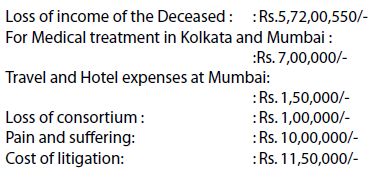
The Apex Court held that the deceased was earning $ 30,000 per annum at the time of her death. The appellant-doctors and the Hospital could not produce any evidence to rebut the claims of the claimant regarding the qualification of her wife. Further $30,000 per annum earned by the deceased during the time of her death was not from a regular source of income and she would have earned lot more had it been a regular source of income, having regard to her qualification and the job for which she was entitled to. Therefore, while determining the income of the deceased, Apex Court relied on the evidence on record for the purpose of determining the just, fair and reasonable compensation and her earning was determined at $40,000 per annum on a regular job. The multiplier method was applied for loss of income of deceased and estimating the life expectancy of a healthy person in the present age as 70 years, the Apex Court was inclined to award compensation accordingly by multiplying the total loss of income by 30. Keeping in view the value of Indian currency, the current value of Indian Rupee was taken at a stable rate of Rs.55/- per 1$ and accordingly under the head of 'loss of income of the deceased' the claimant was held entitled to an amount of Rs.5,72,00,550/- which is calculated as [$40,000+(30/100x40,000$)-(1/3 x 52,000$) x 30 x Rs.55/- ] = Rs.5,72,00,550/-.
In respect to claim of medical treatment of deceased at Kolkata and Mumbai, the compensation was enhanced to the tune of Rs. 7,00,000/-. The claimant was also awarded an amount of Rs.1,50,000/- as compensation towards Travel and Hotel expenses at Bombay.
Hon'ble Apex Court while calculating Non-pecuniary damages has considered various facts and precedents e.g. Arun Kumar Agarwal Vs. National Insurance Company, wherein it has been held that in India the courts have recognized that the contribution made by the wife to the house is invaluable and cannot be computed in terms of money. The gratuitous services rendered by the wife with true love and affection to the children and her husband and managing the household affairs cannot be equated with the services rendered by others. A wife/mother does not work by the clock. She is in the constant attendance of the family throughout the day and night unless she is employed and is required to attend the employer's work for particular hours. She takes care of all the requirements of the husband and children including cooking of food, washing of clothes, etc. She teaches small children and provides invaluable guidance to them for their future life. A housekeeper or maidservant can do the household work, such as cooking food, washing clothes and utensils, keeping the house clean, etc., but she can never be a substitute for a wife/mother who renders selfless service to her husband and children. It was also observed that it is not possible to quantify any amount in lieu of the services rendered by the wife/mother to the family i.e. the husband and children. However, for the purpose of award of compensation to the dependants, some pecuniary estimate has to be made of the services of the housewife/mother. In that context, the term "services" is required to be given a broad meaning and must be construed by taking into account the loss of personal care and attention given by the deceased to her children as a mother and to her husband as a wife. They are entitled to adequate compensation in lieu of the loss of gratuitous services rendered by the deceased. The amount payable to the dependants cannot be diminished on the ground that some close relation like a grandmother may volunteer to render some of the services to the family which the deceased was giving earlier.
In a three judge Bench decision Apex Court in the case of Rajesh & Ors. Vs. Rajvir Singh and Ors.3, this Court held that "The concept of non-pecuniary damage for loss of consortium is one of the major heads of award of compensation in other parts of the world more particularly in the United States of America, Australia, etc. English Courts have also recognized the right of a spouse to get compensation even during the period of temporary disablement. By loss of consortium, the courts have made an attempt to compensate the loss of spouse's affection, comfort, solace, companionship, society, assistance, protection, care and sexual relations during the future years. Unlike the compensation awarded in other countries and other jurisdictions, since the legal heirs are otherwise adequately compensated for the pecuniary loss, it would not be proper to award a major amount under this head. Keeping in view all these, the Apex Court awarded Rupees One Lakh for loss of consortium."
The claim of Rs.4,50,00,000/- by the claimant Under the heading of loss due to pain and suffering was held excessive. A lump sum amount of Rs.10 lakhs was awarded to the claimant following the Nizam Institute's case (supra) and also applying the principles laid in Kemp and Kemp on the "Quantum of Damages", under the head of 'pain and suffering of the claimant's wife during the course of treatment'.
In summary, the details of compensation under different heads are hereunder:
Citing an earlier apex court judgment holding the right to health a fundamental right guaranteed under the Constitution's Article 21, the court said doctors and hospitals are to be dealt with strictly if found "negligent with the patients who come to them pawning all their money with the hope to live a better life with dignity". "The patients irrespective of their social, cultural and economic background are entitled to be treated with dignity which not only forms their fundamental right but also their human right".
Noting an increasing number of medical negligence cases coming before the consumer forums, the court said it hopes this verdict "acts as a deterrent and a reminder to those doctors, hospitals, the nursing homes and other connected establishments who do not take their responsibility seriously".


Source: www.mondaq.com
Read More...

How India’s Elites Encourage Rape

While one horror story after another emerges from India’s countryside, its intellectuals seem confused about where to draw the line against rape in their own circles.
DELHI — The words “Uttar Pradesh,” the name of the largely impoverished and rural state in northeast India between New Delhi and Nepal, have come to be synonymous with rape. More than 3,000 cases were registered last year, according to official statistics. Nobody can say how many go unreported, and the horror stories just keep on coming. Worse still, in the aftermath of the shocking gang rape and murder of two teenage girls found hanging from a tree on May 27 in Badaun, Uttar Pradesh, there has been an alarming spike in crimes against women there.

It’s not like the rest of the country feels much safer. On July 11, a village council in Jharkhand, Bihar, ordered the rape of a 14-year-old girl as punishment for a crime her brother committed. And this is not the first time that the kangaroo courts of rural India have made such appalling judgments. Recently another woman was shot dead for resisting rape in Meghalaya. Since the highly publicized gang rape and murder of a young woman in Delhi in 2012, such reports have become ever more common.

But even as the women of this country have been reminded again and again of their helplessness, the intellectuals and political class have taken to debating the nuances of rape and toying with definitions of feminism. A striking variety of reactionary voices that exercise influence—from the police force to politicians, the judiciary to journalists—combine to paralyze the discourse on crimes against women as the culture of rape is tacitly emboldened from the top, sometimes with unabashed denial and other times with apathetic silence.

In June, Nihalchand Meghwal, a minister in the cabinet of newly elected Prime Minister Narendra Modi, was accused of rape. Modi’s administration has remained silent, taking no action against him, not even a suspension pending an investigation.  Last month a member of parliament echoed the views of the Jharkhand village council when he talked about killing the men among his rivals and raping the women.

But it is indeed in Uttar Pradesh that we see the deepest sympathy for this  deleterious machismo. Instead of checking the lawlessness, the state’s chief minister, Akhilesh Yadav, has mostly whined about the press picking on him. When three repeat offenders found guilty in an infamous 2013 rape case in Mumbai were sentenced to death, the head of the ruling party in Uttar Pradesh (and Akhilesh’s father)  went out of his way to object, suggesting boys will be boys and “men make mistakes.”

Uglier still, a day after the Badaun incident was reported, Naresh Agarwal, another member of the Uttar Pradesh ruling party, compared the victims to animals and suggested the victims went willingly with their attackers. “Today, no one takes away even a domestic animal of another person forcefully,” he said.

Outside India, many people have seen Shekhar Kapur’s 1994 film “Bandit Queen,” set in Uttar Pradesh. “Animals, drums, illiterates and women are worthy of being beaten,” it begins, citing a line from the Manu Smriti, a sacred and authoritative Hindu text. But Kapur, who went on to direct “Elizabeth” with Cate Blanchett, is not a typical Bollywood director and “Bandit Queen” was not a typical Bollywood film. (For something more commonplace, check out a widely viewed YouTube compilation, “No Country For Women.”)

“Bandit Queen” was based on the life of Phoolan Devi, a female gangster in Uttar Pradesh infamous for a massacre at Behmai in 1981 in which she was alleged to have murdered 22 Thakur (upper caste) men to avenge her gang rape by members of that community. Through the fictionalized biopic, a revenge fantasy, Kapur conveyed the truth about the setting: the deeply embedded caste system, patriarchal traditions and decadent police forces that plague parts of Uttar Pradesh, creating a cesspool for rape culture to thrive.

As the rape epidemic continues to plague rural India, albeit with more coverage in the press, the urban intelligentsia have been hitting new lows in their attempts to parse the complexity of women’s issues.

Last month, a discussion about a high-profile harassment case went awry on NDTV, an Indian news channel, when Talvin Singh, a veteran journalist, asked her fellow panelists to consider classifying crimes against women. The context was a debate about the legitimacy of famous Bollywood actress Preity Zinta accusing her former boyfriend and current business partner. As Zinta’s case received a lot of media attention in the responsible press as well as the tabloids,  Singh had lambasted Zinta on Twitter:

"Shame on Preity Zinnia for making a molestation out of a tiff between ex-lovers. When little girls are raped and hanged for nothing.”

“Clarification: in a country with vile, daily crimes against women it is wrong for privileged women to file trivial cases.”

Singh contrasted the case with the Badaun atrocity and argued that Zinta shouldn’t be wasting the country’s resources—“the tax payer’s money” and police time—over a fracas wherein Wadia allegedly manhandled, verbally abused, and threatened her.  Singh went on to say that Indian women should beware of adopting a western code of feminism. When a movie star like Zinta reports a case like that, Singh said, “real rape cases get trivialized.”

The other panelist, author and columnist Shobhaa De, accused Singh of encouraging women to bite the bullet if the brutality meted out to them was not truly egregious.

One of the most difficult cases for the country’s elite involved  the investigative magazine Tehelka. In 2012 it published a groundbreaking a piece of reportage, ”The Rapes Will Go On,” which exposed the disturbing views of the Delhi police on crimes against women, and emphasized the dire need for gender-sensitization in the force. The sting operation showed that senior cops were suspicious of most women who reported rapes, and were inclined to believe that it was a ploy on the woman’s part to malign the man’s reputation.

Then in November last year, the press gorged on the evident hypocrisy when Tehelka’s editor-in-chief and co-founder, Tarun Tejpal, was accused of sexually molesting a colleague. Once again, we heard special pleading among the elites: some suggested that the victim could have resolved the matter privately and it was enough that Tejpal came clean and took a hiatus of six months from the publication. Indeed, when the news had just broken, the famous poet and lyricist Javed Akhtar vaguely ennobled Tejpal’s admission of guilt, via Twitter:

"It is a shame that someone with such impeccable values has committed such an act but unlike some, he has the guts to accept and repent."

The kind of absurdity that is entertained in the conversation about women’s issues in India is scary. In effect, well-meaning intellectuals are asking us to shorten our spectrum of crimes against women so that we can focus on extreme cases of rape and murder in parts of society they like to think are far away from their own.

In a country where crimes against women sometimes seem like an unconquerable epidemic, it’s best to take context out of the equation, and stick to the precision of the legal framework.  That’s already bad enough:  according to the Indian judiciary, in the “context” of marriage, forced sexual intercourse is not a cognizable offense.  Singh calling Zinta’s grievance a “tiff between ex-lovers” also gets a nod of approval by the legislative powers that be. According to the law, the rape of a separated wife carries lesser punishment (two to seven years imprisonment) than the rape of any other woman (seven years to life).

When a crime against a woman is reported—and this ought to be obvious—any degree of violation should be taken seriously.

Source: www.thedailybeast.com
Read More...

State-wise map of Election dates for Lok Sabha polls 2014

Source: DNA India

Read More...