Showing posts with label judgments. Show all posts

498-A used as a weapon rather than a shield:

click on the left side arrow for full width:

To download click on the link  Google Docs , click File, save as doc type    
Read More...

Medical Negligence - Legal Aspect In India

Article by Rohit K.Gupta and Vijaya Singh

Civil Appeal No.2867 of 2012 with Civil Appeal No.692 of 2012 with Civil Appeal No.2866 of 2012 with Civil Appeal No.731 of 2012 Civil Appeal No.858 of 2012-Decided on 24-10-2013.

Bench of Hon'ble S.C. comprising S. J Mukhopadhaya and V. Gopala Gowda , JJ.

Hon'ble Apex Court in matter 'Dr. Balram Prasad Vs. Dr. Kunal Saha & Ors.' & other connected cross appeals1 has recently awarded a historic verdict having a major impact on medical negligence and standard of medical care in India.
The Supreme Court vide its Judgment enhanced the compensation amount of Rs 1.73 crore, which was awarded by the National Consumer Dispute Redressal Commission (NCDRC) in 2011 to the tune of Rs 5.96 crore and asked the Kolkata- based Advanced Medicare and Research Institute (AMRI) and the doctors to pay the amount and also asked to pay interest at the rate of 6 per cent from the date of filing of the complaint in 1999 till the actual date of payment to Kunal Saha, a US-based Indian- origin doctor for medical negligence, which led to the death of his wife in 1998.
The NCDRC earlier found no negligence by doctors or AMRI and had dismissed the case in 2006. The Supreme Court in 2009 had held AMRI and the doctors guilty of negligence and the case was referred to the NCDRC for the sole purpose of determining quantum of compensation. The National Consumer Dispute Redressal Commission (NCDRC) earlier in 2011 had awarded Rs.1.73 crore. Cross appeals were also filed by AMRI and three doctors against the Commission's award. The Apex Court in its Judgment has partly allowed the appeals of claimant.
Hon'ble Apex court hold the three doctors and the hospital culpable to civil liability for medical negligence which had led to the death of Anuradha, a child psychologist and wife of claimant Dr. Kunal Saha, who had come to her home town Kolkata in March 1998 on a summer vacation. Deceased complained of skin rashes on April 25 and consulted Dr Sukumar Mukherjee, who, advised her only to take rest without prescribing any medicine. However, skin rashes resurfaced again with greater passion in early May. Dr Mukherjee prescribed Depomedrol injection 80 mg twice daily to be taken on daily basis, however this prescription of Dr. Mukherjee was not approved by experts at the apex court, at the apex court. Administration of injection led to deterioration of Anuradha's condition, following which she had to be admitted at AMRI on 11 May under Dr Mukherjee's supervision and subsequently she was shifted to Mumbai's Breach Candy Hospital, and her diagnosis stated that she was diagnosed to be suffering from lifethreatening disease called toxic epidermal necrolysis (TEN). Anuradha succumbed to her ailment on May 28, 1998.
Dr. Saha had filed both criminal as well as civil case against the doctors and hospitals on the basis of gross negligence on their part during the treatment, which led the death of her wife.
Hon'ble Supreme Court in 2009 absolved the doctors and the hospitals of criminal liability for medical negligence, however held them culpable of civil liabilities.
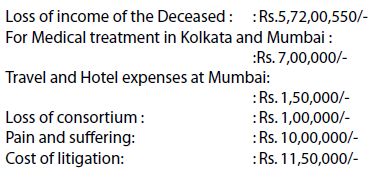
The Apex Court held that the deceased was earning $ 30,000 per annum at the time of her death. The appellant-doctors and the Hospital could not produce any evidence to rebut the claims of the claimant regarding the qualification of her wife. Further $30,000 per annum earned by the deceased during the time of her death was not from a regular source of income and she would have earned lot more had it been a regular source of income, having regard to her qualification and the job for which she was entitled to. Therefore, while determining the income of the deceased, Apex Court relied on the evidence on record for the purpose of determining the just, fair and reasonable compensation and her earning was determined at $40,000 per annum on a regular job. The multiplier method was applied for loss of income of deceased and estimating the life expectancy of a healthy person in the present age as 70 years, the Apex Court was inclined to award compensation accordingly by multiplying the total loss of income by 30. Keeping in view the value of Indian currency, the current value of Indian Rupee was taken at a stable rate of Rs.55/- per 1$ and accordingly under the head of 'loss of income of the deceased' the claimant was held entitled to an amount of Rs.5,72,00,550/- which is calculated as [$40,000+(30/100x40,000$)-(1/3 x 52,000$) x 30 x Rs.55/- ] = Rs.5,72,00,550/-.
In respect to claim of medical treatment of deceased at Kolkata and Mumbai, the compensation was enhanced to the tune of Rs. 7,00,000/-. The claimant was also awarded an amount of Rs.1,50,000/- as compensation towards Travel and Hotel expenses at Bombay.
Hon'ble Apex Court while calculating Non-pecuniary damages has considered various facts and precedents e.g. Arun Kumar Agarwal Vs. National Insurance Company, wherein it has been held that in India the courts have recognized that the contribution made by the wife to the house is invaluable and cannot be computed in terms of money. The gratuitous services rendered by the wife with true love and affection to the children and her husband and managing the household affairs cannot be equated with the services rendered by others. A wife/mother does not work by the clock. She is in the constant attendance of the family throughout the day and night unless she is employed and is required to attend the employer's work for particular hours. She takes care of all the requirements of the husband and children including cooking of food, washing of clothes, etc. She teaches small children and provides invaluable guidance to them for their future life. A housekeeper or maidservant can do the household work, such as cooking food, washing clothes and utensils, keeping the house clean, etc., but she can never be a substitute for a wife/mother who renders selfless service to her husband and children. It was also observed that it is not possible to quantify any amount in lieu of the services rendered by the wife/mother to the family i.e. the husband and children. However, for the purpose of award of compensation to the dependants, some pecuniary estimate has to be made of the services of the housewife/mother. In that context, the term "services" is required to be given a broad meaning and must be construed by taking into account the loss of personal care and attention given by the deceased to her children as a mother and to her husband as a wife. They are entitled to adequate compensation in lieu of the loss of gratuitous services rendered by the deceased. The amount payable to the dependants cannot be diminished on the ground that some close relation like a grandmother may volunteer to render some of the services to the family which the deceased was giving earlier.
In a three judge Bench decision Apex Court in the case of Rajesh & Ors. Vs. Rajvir Singh and Ors.3, this Court held that "The concept of non-pecuniary damage for loss of consortium is one of the major heads of award of compensation in other parts of the world more particularly in the United States of America, Australia, etc. English Courts have also recognized the right of a spouse to get compensation even during the period of temporary disablement. By loss of consortium, the courts have made an attempt to compensate the loss of spouse's affection, comfort, solace, companionship, society, assistance, protection, care and sexual relations during the future years. Unlike the compensation awarded in other countries and other jurisdictions, since the legal heirs are otherwise adequately compensated for the pecuniary loss, it would not be proper to award a major amount under this head. Keeping in view all these, the Apex Court awarded Rupees One Lakh for loss of consortium."
The claim of Rs.4,50,00,000/- by the claimant Under the heading of loss due to pain and suffering was held excessive. A lump sum amount of Rs.10 lakhs was awarded to the claimant following the Nizam Institute's case (supra) and also applying the principles laid in Kemp and Kemp on the "Quantum of Damages", under the head of 'pain and suffering of the claimant's wife during the course of treatment'.
In summary, the details of compensation under different heads are hereunder:

Citing an earlier apex court judgment holding the right to health a fundamental right guaranteed under the Constitution's Article 21, the court said doctors and hospitals are to be dealt with strictly if found "negligent with the patients who come to them pawning all their money with the hope to live a better life with dignity". "The patients irrespective of their social, cultural and economic background are entitled to be treated with dignity which not only forms their fundamental right but also their human right".
Noting an increasing number of medical negligence cases coming before the consumer forums, the court said it hopes this verdict "acts as a deterrent and a reminder to those doctors, hospitals, the nursing homes and other connected establishments who do not take their responsibility seriously".


Source: www.mondaq.com
Read More...

State of Bihar and Others Vs. Nirmal Kumar Gupta

State of Bihar and Others Vs. Nirmal Kumar Gupta

[Civil Appeal No. 128 of 2013 arising out of S.L.P. (C) No. 19133 of 2009]

Dipak Misra, J.

1. Leave granted.

2. The pivotal issue that emerges for consideration in this appeal is whether the Division Bench of the High Court of Judicature at Patna has correctly interpreted the effect and impact of the Bihar Excise (Settlement of Licences for retail sale of country/spiced country liquor) Rules, 2004 (for short "the Rules") and the sale notification published by the Collector of Kishanganj in Excise Form 127 for various excise shops in groups in the said district for the year 2006- 07 and the terms of licence.

3. As the factual matrix would exposit, the Collector, Kishanganj, got the sale notification in Excise Form 127 issued for settlement of various excise shops in various groups in the district of Kishanganj for the financial year 2006-07 which stipulated that the settlement shall be made on 23rd March, 2006 on auction-cum-tender basis and, accordingly, applications were invited from interested persons. As the settlement could not be effected in respect of group 'ka' shops in the said district, the Collector issued a second notification on 17th May, 2006 for the said group 'ka' which consisted of six country spirit shops and three spiced country spirit shops.

On 5th June, 2006, the group 'ka' excise shops were settled in favour of the respondent at a monthly licence fee of Rs.8,29,600/-. The respondent deposited the advance security of Rs.8,29,594/- on 7th June, 2006 and further Rs.8,29,600/- on 22nd June, 2006. The Collector, Kishanganj moved the Commissioner for his approval and the same was granted on 1st July, 2006 in the office of the Collector on 5th July, 2006 and on that day itself, the licence was issued in favour of the respondent- licencee.

It is the case of the appellant that as the respondent did not deposit the requisite 1/4th amount of the annual licence fee as advance security as prescribed under the Rules but did so in three instalments, there was delay in obtaining the approval from the Excise Commissioner in terms of Rule 17(kha) of the Rules. Despite the delay in the payment of the advance deposit, the Collector had recommended his case for approval and, eventually, the Commissioner approved the grant of licence in respect of group 'ka' shops and, ultimately, the licence was issued, as stated earlier, on 5th July, 2006.

4. As there was breach of the conditions of the licence, a demand was raised for the period commencing 5th June, 2006 to 5th July, 2006 by the Excise Superintendent, Araria-cum-Kishanganj on 27th March, 2007. On receipt of the demand notice, the respondent moved the Excise Superintendent on 29th April, 2007 asking him to withdraw the demand on the ground that he had not utilized the privilege during that period. Thereafter, he challenged the demand notice before the Excise Commissioner, who rejected the application vide order dated 18th September, 2008. Being grieved by the said order he moved the High Court invoking the writ jurisdiction in CWJC No. 16577 of 2008.

5. The High Court referred to Rules 16, 17, 20, 22 and 24 and recorded its opinion in the following manner: - "That group of shops have been settled in favour of the petitioner in the midst of excise year, is not in dispute. It is also a fact that on 5th June, 2006, the bid made by the petitioner for group 'ka' excise shops of Kishanganj District was highest and accepted by the auctioning authority by such acceptance is subject to approval of the Excise Commissioner. There also does not seem to be any dispute that there was some default on the part of the petitioner in payment of the advance security amount. However, the default seems to have been condoned as despite the said default, his bid dated 5th June, 2006 was not cancelled and licence was issued in Form 26C of the Rules on 5th July, 2006.

Rules 16 and 17 of the Rules, when read together, would show that the final acceptance of the bid by the auctioning authority, by itself, does not entitle the bidder to get the licence as the said bid has to be accepted by the Commissioner of Excise and only after it is accepted by the Commissioner, then the licence is issued. In the backdrop of the aforesaid legal position, when we turn to the facts of the present case, it would be seen that although highest bid of the petitioner was accepted on 5th June, 2006 but it was only on 30th June, 2006 that the Licensing Authority recommended to the Commissioner of Excise for approval of settlement and it was approved by the Excise Commissioner, Bihar on 1st July, 2006 and after receipt of the approval from the Excise Commissioner on 5th July, 2006, the licence was issued by the Licensing Authority on that date. Surely, in the backdrop of the facts that the licence was issued on 5th July, 2006 the petitioner could not have been fastened with the liability to pay licence fee from 5th June, 2006." [Underlining is ours]

6. Questioning the correctness of the aforesaid conclusion, it is submitted by Mr. Gopal Singh, learned counsel for the State of Bihar, that the High Court has fallen into error by construing that the default has been condoned though there is no concept of condonation in such a trade. It is urged by him that as the requisite advance licence fee was not deposited as per the Rules, the approval could not be obtained earlier and hence, the Department, not being at fault, should not suffer the loss of revenue more so when the licencee had accepted the conditions enumerated in the licence. That apart, submits Mr. Singh, as per the Rules, in such a situation, the respondent was legally bound to pay the licence fee from the date of settlement.

7. Mr. Shantanu Sagar, learned counsel appearing for the respondent, per contra, has submitted that the High Court has correctly determined the controversy that the liability would be from the date of issue of the licence and not earlier than that, for unless the licence is issued, he cannot trade in liquor and further it cannot be said that the State has parted with the exclusive privilege.

8. To appreciate the controversy, it is necessary to refer to certain Rules. Rule 16 of the Rules deals with the acceptance of bid or tenders. It reads as follows: - "16. Acceptance of bid or tenders.- (1) The Auctioning Authority shall not be bound to accept the highest bid or tender or any bid. If the highest bid or tender is not accepted, the licensing officer shall instantaneously declare the date of fresh auction, mentioning the reasons. In such a circumstance, the entire deposited advance money will be refunded to those applicants who do not want to participate in subsequent auction. (2) If the bid amount in any auction is finally accepted, any subsequent offer with regard to that bid shall not be considered. No further negotiation shall be entertained by the Licensing Authority or the officer conducting the auction."

9. Rule 17 of the Rules which provides for final acceptance of the bid is as follows: - "17. Final acceptance of bid. - (a) The recommendation to grant exclusive privilege of retail sale for the shop or group of shops to the person bidding highest, and acceptance under Rule 16, shall be sent to the Commissioner of Excise by the Licensing Officer, and after his acceptance a licence will be issued. (b) The amount of highest bid, accepted will be the annual amount of licence fee."

10. On a perusal of the aforesaid two Rules, it is vivid that the Licensing Officer conducting auction accepts the bid and, thereafter, sends his recommendation for grant of exclusive privilege of retail sale for the shops or group of shops to the Commissioner and after his acceptance, the licence is issued. The pertinent part of this Rule is that the amount of highest bid accepted would be the annual amount of licence fee.

11. Rule 19 provides for payment of advance security in the manner prescribed therein. The said Rule is reproduced hereinbelow: - "19. Payment of Advance Security. - After the declaration of acceptance of the highest bid the Licensing Authority, one fourth, portion of the annual licence fee shall be paid by the highest bidder as advance security in the following manner for due execution of a contract: - a) An amount equivalent to sixth portion of annual licence fee shall be immediately deposited in cash or in the form of Bank Draft. The amount of cash/Bank Draft and that of advance money deposited previously under Rule 11(a) and Rule 11(c) respectively, shall be adjusted in part from security amount. b) The payable remaining amount on account of advance security shall have to be deposited within ten days of auction or before commencement of the licence whichever is earlier."

12. On a plain reading of the said Rule, it is manifest that the highest bidder has to immediately deposit one fourth of the annual licence fee as advance security money in the manner provided in sub-clauses (a) and (b) of the Rule.

13. Rule 20 deals with the consequences of default in advance security. It reads as under: - "20. Default in advance security. - In case of failure to deposit the amount of advance security, as mentioned in Rule 19, within the prescribed time, the settlement and the licence, if issued, shall stand cancelled and the deposited amount, if any, shall be forfeited to the Government. In such a circumstance, a re-auction or alternative arrangement shall be made by the Licensing Authority."

14. The aforesaid Rule, when properly scrutinized, clearly lays the postulate that if the advance security amount is not deposited in accordance with the time limit prescribed under Rule 19, the settlement and the licence, if issued, shall stand cancelled and the deposited sum, if any, shall be forfeited to the Government. Thus, there is a distinction between settlement and issue of licence.

15. Rule 23 deals with adjustment/refund of advance security amount. It stipulates that the security amount referred to in Rule 19 shall be refunded at the end of the settlement period if all the dues and claims of the State Government with regard to the auctioned shop or group of shops have already been paid by the licencee.

16. Rule 24 deals with the commencement of the period of licence. It is as follows: - "24. Commencement of the period of licence. - A licence issued in favour of any auction-purchaser shall be effective from 1st April of the excise year unless the Licensing Authority orders otherwise. The auction-purchaser shall be liable to pay the bid money from the first day of the licence period, even if the licence has been issued thereafter. Provided that if any shop or a group of shops is settled in the midst of the excise year, the licence shall commence from the date of settlement of the shop or the group of shops. The Licensing Authority shall mention details of the shops/licences to be settled and annual minimum guaranteed quantity to be lifted under those licences and the reserved fee thereof, in the sale notification for every excise year."

17. The said Rule has to be carefully x-rayed and understood. It clearly lays down that the licence shall be effective from 1st April of the excise year and the auction-purchaser shall be liable to pay the bid money from the first day of the licence period, even if the licence has been issued thereafter. The proviso further stipulates that if any shop or a group of shops is settled in the midst of the excise year, the licence shall commence from the date of settlement of the shop or the group of shops.

18. The High Court, interpreting the Rule position, has opined that the shops were settled in favour of the respondent in the midst of the year, i.e., on 5th June, 2006, and after obtaining the approval on 1st July, 2006 from the Excise Commissioner, the licence was issued by the Licensing Authority on 5th July, 2006, and, therefore, the demand of licence fee for the period from 5th June, 2006 to 5th July, 2006 is not sustainable.

19. As the factual matrix would reveal, the notification in Form No. 127 was issued on 23rd March, 2006. The terms and conditions of the settlement of excise shops were duly incorporated in the sale notification and as per Rule 8, the terms and conditions mentioned in the notification are deemed to be included in the conditions of the licence. As per the first notification, all the three country spirit shops could not be settled and further steps were taken for settlement and, eventually, the bid of the respondent was accepted on 5th June, 2006 with the annual licence fee of Rs.99,55,200/- or at a monthly fee of Rs.8,29,600/-.

The respondent was required to pay 1/4th of the annual licence fee as advance security money but he failed to do so in time. He deposited the requisite amount in three instalments, i.e., first on 7th June, 2006, second on 22nd June, 2006 and third on 17th July, 2006. As per Rule 19(a), he was required to deposit 1/6th portion of the annual licence fee immediately in cash or in the form of bank draft. The remaining amount of advance security was to be deposited within ten days of the auction or before the commencement of the licence. Thus, the respondent failed to comply with the said Rule.

However, the Collector recommended his case on 30th June, 2006 which was accepted on 1st July, 2006 and the licence was issued on 5th July, 2006. It is worthy to note that thereafter, demand notice of Rs.16,03,893/- was issued by the Excise Superintendent. The Commissioner took note of the fact that out of Rs.74,36,071/-, the licencee had paid Rs.66,36,794/- and, hence, a sum of Rs.7,99,277/- remained to be paid. Be it noted, on 3rd March, 2007, the licence was cancelled for breach of other conditions and in the present case, we are not concerned with those conditions, for the controversy in praesenti only relates to the demand commencing 5th June, 2006 to 5th July, 2006.

20. The High Court has opined that the State had not parted with the exclusive privilege till the licence was issued. Under Rule 24, a licence issued in favour of the auction-purchaser is effective from 1st April of the excise year unless the Licensing Authority orders otherwise and the auction purchaser is liable to pay the bid money from the first day of the licence period even if the licence has been issued thereafter.

That apart, he is supposed to pay the licence fee from the commencement of the settlement period and the licence commences from the date of the settlement. In the case at hand, it was settled on 5th June, 2006. The licence was issued on 5th July, 2006. The principle of condonation of default has been taken recourse to by the High Court on the foundation that despite default in making deposit of advance security, the licensing officer recommended his case for approval to the Commissioner of Excise.

The default, as we perceive, comes into play if there is violation of Rule 19 which stipulates for advance security. There is no dispute over the fact that there was delay. The respondent was clearly responsible for the same. The licensing officer thought it appropriate to recommend his case and the Excise Commissioner did approve it and on receipt of the approval, the licence was issued on the same day. The respondent accepted the licence knowing fully well the terms and conditions of the licence and that he has to pay the licence fee from the date of the settlement.

21. At this juncture, we may usefully address to the issue whether in a case of this nature, the principle of condonation of default by way of conduct can be attracted. First of all, under the Rules, the authorities are entitled to forfeit the amount deposited when there is non-compliance of the Rules. It is to be borne in mind that the nature of the trade has also its own significance. In Amar Chandra Chakraborty v. The Collector of Excise, Govt. of Tripura, Agartala and others[1], this Court held thus: - "Trade or business in country liquor has from its inherent nature been treated by the State and the society as a special category requiring legislative control which has been in force in the whole of India since several decades. In view of the injurious effect of excessive consumption of liquor on health this trade or business must be treated as a class by itself and it cannot be treated on the same basis as other trades while considering Article 14."

22. In the case of Nashirwar etc. v. State of Madhya Pradesh and Others[2], this Court opined that the State has the exclusive right or privilege in manufacturing and selling of liquor and a citizen has no fundamental right to do business in liquor. It has been further ruled that it is within the police power of the State to enforce public morality by prohibiting trade in noxious or dangerous goods.

23. In Har Shandar and Others etc. v. The Deputy Excise and Taxation Commissioner and others etc.[3], the Constitution Bench reiterated the principles that there is no fundamental right to do trade or business in intoxicant and the State has the authority to prohibit every form of activity in relation to intoxicant including manufacture, storage, export, import, sale and possession. It has also been laid down that a wider right to prohibit absolutely would include the narrower right to permit dealings in intoxicants in such terms of general application as the State deems expedient.

24. In State of M.P. and others etc. v. Nandlal Jaiswal and others etc.[4], this Court held that trading in liquor is inherently punitive in nature.

25. In M/s. Khoday Distilleries Ltd. v. State of Karnataka[5], the Constitution Bench has ruled that the right to carry on occupation, trade or business does not extend to trade or business or any activities which are injurious and against the welfare of the general public. It is further held therein that a citizen has no fundamental right to do business in intoxicant as liquor. 26. In M/s. Ugar Sugar Works Ltd. v. Delhi Administration and others[6], this Court reiterated the said principle and emphasized on the regulatory powers of the State.

26. In State of M.P. and Ors. etc. etc. v. Nandlal Jaiswal and Ors. etc. etc.[7], a two-Judge Bench, while expressing the view that Article 14 of the Constitution is attracted to grant of exclusive right or privilege for manufacture and sale of liquor as it involves the State largesse, has stated thus:- "33. But, while considering the applicability of Article 14 in such a case, we must bear in mind that, having regard to the nature of the trade or business, the Court would be slow to interfere with the policy laid down by the State Government for grant of licences for manufacture and sale of liquor.

The Court would, in view of the inherently pernicious nature of the commodity allow a large measure of latitude to the State Government in determining its policy of regulating, manufacture and trade in liquor. Moreover, the grant of licences for manufacture and sale of liquor would essentially be a matter of economic policy where the Court would hesitate to intervene and strike down what the State Government had done, unless it appears to be plainly arbitrary, irrational or mala fide." [Emphasis supplied]

27. In P.N. Krishna Lal and Ors. v. Govt. of Kerala and Anr.[8], the Court expressed thus:- "28. dealing in liquor inherently pernicious or dangerous goods which endangers the community or subversive of morale, is within the legislative competence under the Act. The State has thereby the power to prohibit trade or business which is injurious to the health and welfare of the public and the elimination and exclusion from the business is inherent in the nature of liquor business. The power of the legislature to evolve the policy and its competence to raise presumptive evidence should be considered from this scenario." [Emphasis supplied]

28. In Secretary to Govt., Tamil Nadu and Anr. v. K. Vinayagamurthy[9], it has been held as follows: "7. So far as the trade in noxious or dangerous goods are concerned, no citizen can claim to have trade in the same and the intoxicating liquor being a noxious material, no citizen can claim any inherent right to sell intoxicating liquor by retail. It cannot be claimed as a privilege of a citizen of a State. That being the position, any restriction which the State brings forth, must be a reasonable restriction within the meaning of Article 19(6) and reasonableness of the restriction would differ from trade to trade and no hard and fast rule concerning all trades can be laid down"

29. In State of Punjab and Anr. v. Devans Modern Breweries Ltd. and Anr.[10], it has been reiterated that trade in liquor is considered inherently noxious and pernicious.

30. We have referred to the aforesaid decisions to accentuate the nature of the trade, the role of the State, the economic concept of the policy, limited attractability of Article 14 of the Constitution as regards the legislation or policy, the restriction inherent in the policy and the duty of the court. On the aforesaid touchstone, we are required to see whether the doctrine of condonation by conduct, especially in the present case, could have been taken recourse to by the High Court. The respondent had availed the benefit of the licence being fully aware of the Rules, notification and the terms incorporated in the licence.

The Rules provide that he has to pay from the date of the settlement and in this case, the settlement took place on 5th June, 2006. In view of what has been engrafted in the Rules, there cannot be any trace of doubt that the respondent has to be made liable to pay the licence fee from the date of the settlement. There could not have been condonation of default. Such a concept is alien to the present nature of trade and a licencee cannot claim any benefit under the same as the whole thing is governed by the command of the Rules.

That apart, we are unable to subscribe to the interpretation placed by the High Court that the auction-purchaser is liable to pay from the date of issuance of licence but not from the date of the settlement as that runs counter to the plain language of Rule 24. Reading the Rules in a comprehensive manner in juxtaposition with the notification which forms the terms and conditions of the licence and the nature of the trade, the irresistible conclusion is that the liability accrued from the date of the settlement and, therefore, we find that the order passed by the Excise Commissioner was just and proper and there was no warrant on the part of the High Court to interfere with the same.

31. Consequently, the appeal is allowed, the order passed by the High Court is set aside and that of the Excise Commissioner is restored. The parties shall bear their respective costs.

............................J. [K. S. Radhakrishnan]

............................J. [Dipak Misra]

New Delhi;

January 08, 2013
Read More...

Hema Vs. State, thr. Inspector of Police, Madras

Hema Vs. State, thr. Inspector of Police, Madras

[Criminal Appeal No. 31 of 2013 arising out of S.L.P. (CRL.) No. 9190 of 2011]

P.Sathasivam,J.

1. Leave granted.

2. This appeal is directed against the final judgment and common order dated 29.04.2011 passed by the Madurai Bench of the Madras High Court in Criminal Appeal (MD) No. 37 of 2004 whereby the High Court dismissed the appeal filed by the appellant herein (A-5 therein) while confirming the judgment dated 28.07.2004, passed by the Court of Principal Special Judge for CBI Cases, Madurai.

3. Brief facts:

a. According to the prosecution, during the year 1992, the appellant herein (A-5), along with other accused persons (A-1 to A-4 therein)had entered into a criminal conspiracy to cheat the Regional Passport Office, Trichy in order to obtain passports on the basis of creating ante-dated passport applications with duplicate file numbers, so as to make them appear as old cases, accompanied by forged enclosures such as police verification certificates etc. In pursuance of the said conspiracy, A-2being the Lower Division Clerk in the Regional Passport Office, Trichy fraudulently received and processed 42 forged passport applications filed by one Goodluck Travels, Trichy run by A-3 with the assistance of A-4 and A-5 (the appellant herein) and made false endorsement of reference numbers, fee certifications etc. and A-1, being the Superintendent of the Regional Passport Office, Trichy, by abusing his official position, granted orders for the issue of passports in respect of the said 42 applications.

b. In pursuance of the same, on 09.02.1993, the District Crime Branch at Ramanathapuram, Tamil Nadu received a letter from Deputy Superintendent of Police (DSP), DCRB Ramanad, containing a complaint given by the Passport Officer, Trichy. On the basis of the same, a case was registered by the District Crime Branch, Ramanad as Criminal Case No. 1 of 1993 under Sections 419, 420, 465 and 467 of the Indian Penal Code, 1860 (in short 'the IPC').

c. When the Inspector of Police, DCB, took up the investigation, the CBI intervened and filed a First Information Report being RC-21(A)/93 on11.05.1973 under Section 120-B read with Sections 420, 467, 468 and 471 of the IPC and Section 13(2) read with Section 13(1)(d) of the Prevention of Corruption Act, 1988 (in short 'the PC Act'). After investigation, the case was committed to the Special Court for CBI Cases, Madurai and numbered as CC No. 38 of 1996. On 01.08.1996, the Special Court, framed charges under Section 120-B of IPC against A-1 to A-5 and under Sections 420, 465and 471 of IPC against the appellant herein (A-5) and specific charges under Section 13(1)(d) read with Section 13(2) of the PC Act against A-1and under Sections 420, 467, 468 and 471 of IPC and under Section 13(1)(d)read with Section 13(2) of the PC Act against A-2 and under Sections 420,465 and 471 of IPC against A-3.

d. By order dated 28.07.2004, the Principal Special Judge convicted and sentenced A-1 to A-3 and A-5. In the present appeal, we are concerned only with A-5 who was convicted and sentenced to undergo RI for 2 years along with a fine of Rs.5,000/-, in default, to further undergo RI for 6 months for each of the offences under Sections 120-B, 420 read with Sections 511,465 and 471 of IPC. (Total fine of Rs. 15,000/-).

e. Aggrieved by the said order of conviction and sentence, the appellant herein filed Criminal Appeal No. 37 of 2004 before the Madurai Bench of the Madras High Court. By impugned order dated 29.04.2011, the High Court dismissed the same along with other set of appeals filed in respect of other accused and confirmed their conviction and sentence awarded by the trial Court. Being aggrieved by the judgment of the High Court, A-5 alone has preferred this appeal by way of special leave before this Court.

4. Heard Mr. S. Prabhakaran, learned counsel for the appellant and Mr. H.P. Rawal, learned Additional Solicitor General for the respondent-CBI.Contentions:

5. Mr. S. Prabhakaran, learned counsel for the appellant, after taking us through the entire materials including the order of the trial Court and the High Court submitted that the initial proceedings by the State Crime Branch and the subsequent proceedings by the CBI cannot be permitted, hence, the entire investigation is to be thrown out. In other words, according to him, parallel proceedings by the State Crime Branch and the CBI are not permissible. In addition to the same, he submitted that the original seals and rubber stamps have not been seized from the police officials and those were not produced by the I.O. to prove that the seals and stamps were forged.

He further submitted that the prosecution has failed to exhibit the FSL report with regard to the impression of seals of M.Os 1 to 3 alleged to have been recovered by the prosecution at the instance of A-3 despite the same were being sent by Shri Madavanan (PW-30),Inspector of Police. According to him, the specimen signatures of Shri Natarajan (PW-16), DSP, and R. Muniyandi (PW-29), Sub-Inspector of Police, have not been sent to the hand writing expert for his opinion. Further, the seal and specimen signature of attesting officer, viz., Dr. Muthu (PW-18) were not collected by the CBI to prove that the seal and specimen signature were forged.

There is no document or indication found in Exh.P-3to P-43 to show that they were sent by M/s Goodluck Travels to the Passport Office at Trichy. Finally, he submitted that inasmuch as the certificates issued by the Village Administrative Officers that the applicants were not the residents of the place mentioned in the application form, their reports have no legal sanctity in the absence of certification by the Tahsildar.

6. Mr. Rawal, learned ASG appearing for the CBI, met all the contentions. He submitted that the claim that parallel proceedings by the District Crime Branch (DCB) and the CBI, though not urged before the trial Court, High Court and even in the grounds of appeal, however, there is no legal basis for such claim. Even otherwise, according to him, if there is any defect in the investigation, the accused cannot be acquitted on this ground. By taking us through the evidence relied on by the prosecution, findings by the trial Court and the High Court, learned ASG submitted that in view of concurrent decision of two courts, in the absence of any per varsity, interference by this Court exercising jurisdiction under Article 136 is not warranted. Discussion:

7. With regard to the main objection as to parallel proceedings as claimed by Mr. Prabhakaran, learned counsel for the appellant, as state dear lier, this objection was not raised either before the trial Court or before the High Court and even in the grounds of appeal before this Court, however, considering the fact that we are dealing with a matter pertaining to criminal prosecution, we heard the counsel on this aspect. He pointed out that the first FIR dated 09.02.1993 was registered at the instance of the complaint by Shri V.A. Britto, Passport Officer, Trichy.

The said FIR has been marked as Exh.P-214. He also pointed out that the second FIR, at the instance of the Special Police Establishment, Madras Branch, was lodged on 11.05.1993 against three persons, namely, (1) P. Durai, Superintendent, Passport Office, Trichy (2) P.M. Rajendran, LDC, Passport Office, Trichy and (3) M/s Goodluck Travels, Thiruvadanai, Ramanad District, Tamil Nadu. By taking us through the said reports, particularly, the second FIR, the counsel for the appellant has pointed out that the said report proceeds on the basis of credible information from a reliable source. The same was entertained and registered as R.C. No. 21(A)/93 by S. Arulnadu, Inspector of Police, SPE: CBI: ACB: Madras. By pointing out these details, it is contended by the counsel for the appellant that the course adopted by the prosecution in examining certain persons by the DCB, namely, the State Police and the remaining persons by the CBI is not permissible.

8. It is settled law that not only fair trial, but fair investigation is also part of constitutional rights guaranteed under Articles 20 and 21 of the Constitution of India. Accordingly, investigation must be fair, transparent and judicious and it is the immediate requirement of rule of law. As observed by this Court in Babubhai vs. State of Gujarat and Others, 2010 (12) SCC 254, the Investigating Officer cannot be permitted to conduct an investigation in a tainted and biased manner. It was further observed that where non-interference of the Court would ultimately result in failure of justice, the Court must interfere.

Though reliance was placed on the above decision by the appellant, it is not in dispute that in that case, the High Court has concluded by giving detailed reasons that the investigation has been totally one-sided based on malafide. Further, in that case, the charge-sheets filed by the Investigating Agency in both thecases were against the same set of accused. This was not the situation in the case on hand. Though the State Crime Branch initiated investigation, subsequently, the same was taken over by the CBI considering the volume and importance of the offence.

9. In this regard, Mr. Rawal, learned ASG by drawing our attention to the relevant provisions of the Delhi Special Police Establishment Act, 1946submitted that the course adopted by the CBI is, undoubtedly, within the ambit of the said Act and legally sustainable. Section 5 of the said Act speaks about extension of powers and jurisdiction of special establishment to other areas. Section 5 of the Act is relevant for our purpose which reads as under:-

"5. Extension of powers and jurisdiction of special police establishment to other areas.-

(1) The Central Government may by order extend to any area (including Railway areas), in a State, not being a Union Territory the powers and jurisdiction of members of the Delhi Special Police Establishment for the investigation of any offences or classes of offences specified in a notification under Section 3.

(2) When by an order under sub-section (1) the powers and jurisdiction of members of the said police establishment are extended to any such area, a member thereof may, subject of any orders which the Central Government may make in this behalf, discharge the functions of a police officer in that area and shall, while so discharging such functions, be deemed to be a member of a police force of that area and be vested with the powers, functions and privileges and be subject to the liabilities of a police officer belonging to that police station.

(3) where any such order under sub-section (1) is made in relation to any area, then, without prejudice to the provisions of sub-section (2) any member of the Delhi Special Police Establishment of or above the rank of Sub-Inspector may subject to any orders which the Central Government may make in this behalf, exercise the powers of the officer in charge of a police station in that area and when so exercising such powers, shall be deemed to be an officer in charge of a police station discharging the functions of such an officer within the limits of his station.

"Sub-section (3) which was inserted with effect from 18.12.1964 by Act 40 of1964 makes it clear that on the orders of the Central Government, any member of the Delhi Special Police Establishment is permitted to exercise the powers of the officer in charge of a police station in that area and while exercising such powers, he shall be deemed to be an officer in charge of a police station concerned discharging the functions of such officer within the limits of his station. In the light of the mandates as provided in sub-section (3), we are of the view that learned ASG is right in contending that there is no infirmity or flaw in continuing the investigation by the officers of the CBI in spite of the fact that the State Crime Branch registered a complaint and proceeded with the investigation to a certain extent.

10. It is also settled law that for certain defects in investigation, the accused cannot be acquitted. This aspect has been considered in various decisions. In C. Muniappan and Others vs. State of Tamil Nadu, 2010 (9)SCC 567, the following discussion and conclusion are relevant which are as follows:- "55. There may be highly defective investigation in a case. However, it is to be examined as to whether there is any lapse by the IO and whether due to such lapse any benefit should be given to the accused. The law on this issue is well settled that the defect in the investigation by itself cannot be a ground for acquittal.

If primacy is given to such designed or negligent investigations or to the omissions or lapses by perfunctory investigation, the faith and confidence of the people in the criminal justice administration would be eroded. Where there has been negligence on the part of the investigating agency or omissions, etc. which resulted in defective investigation, there is a legal obligation on the part of the court to examine the prosecution evidence dehors such lapses, carefully, to find out whether the said evidence is reliable or not and to what extent it is reliable and as to whether such lapses affected the object of finding out the truth. Therefore, the investigation is not the solitary area for judicial scrutiny in a criminal trial. The conclusion of the trial in the case cannot be allowed to depend solely on the probity of investigation.

11. In Dayal Singh and Others vs. State of Uttaranchal, 2012 (8) SCC 263,while reiterating the principles rendered in C. Muniappan (supra), this Court held thus: "18. Merely because PW 3 and PW 6 have failed to perform their duties in accordance with the requirements of law, and there has been some defect in the investigation, it will not be to the benefit of the accused persons to the extent that they would be entitled to an order of acquittal on this ground."

12. In Gajoo vs. State of Uttarakhand, 2012 (9) SCC 532, while reiterating the same principle again, this Court held that defective investigation, unless affects the very root of the prosecution case and is prejudicial to the accused should not be an aspect of material consideration by the Court. Since, the Court has adverted to all the earlier decisions with regard to defective investigation and outcome of the same, it is useful to refer the dictum laid down in those cases: 20. In regard to defective investigation, this Court in Dayal Singh v. State of Uttaranchal while dealing with the cases of omissions and commissions by the investigating officer, and duty of the court in such cases, held as under: (SCC pp. 280-83, paras 27-36)

"27. Now, we may advert to the duty of the court in such cases. In Sathi Prasad v. State of U.P this Court stated that it is well settled that if the police records become suspect and investigation perfunctory, it becomes the duty of the court to see if the evidence given in court should be relied upon and such lapses ignored. Noticing the possibility of investigation being designedly defective, this Court in Dhanaj Singh v. State of Punjab, held: (SCC p. 657, para 5) '5. In the case of a defective investigation the court has to be circumspect in evaluating the evidence. But it would not be right in acquitting an accused person solely on account of the defect; to do so [pic] would tantamount to playing into the hands of the investigating officer if the investigation is designedly defective.' 28. Dealing with the cases of omission and commission, the Court in Paras Yadav v. State of Bihar enunciated the principle, in conformity with the previous judgments, that if the lapse or omission is committed by the investigating agency, negligently or otherwise, the prosecution evidence is required to be examined dehors such omissions to find out whether the said evidence is reliable or not.

The contaminated conduct of officials should not stand in the way of evaluating the evidence by the courts, otherwise the designed mischief would be perpetuated and justice would be denied to the complainant party. 29. In Zahira Habibullah Sheikh (5) v. State of Gujarat, the Court noticed the importance of the role of witnesses in a criminal trial. The importance and primacy of the quality of trial process can be observed from the words of Bentham, who states that witnesses are the eyes and ears of justice. The court issued a caution that in such situations, there is a greater responsibility of the court on the one hand and on the other the courts must seriously deal with persons who are involved in creating designed investigation.

The Court held that: (SCC p. 398, para 42) '42. Legislative measures to emphasise prohibition against tampering with witness, victim or informant have become the imminent and inevitable need of the day. Conducts which illegitimately affect the presentation of evidence in proceedings before the courts have to be seriously and sternly dealt with. There should not be any undue anxiety to only protect the interest of the accused. That would be unfair, as noted above, to the needs of the society. On the contrary, efforts should be to ensure a fair trial where the accused and the prosecution both get a fair deal. Public interest in the proper administration of justice must be given as much importance, if not more, as the interest of the individual accused. In this courts have a vital role to play.' (emphasis in original)

30. With the passage of time, the law also developed and the dictum of the court emphasised that in a criminal case, the fate of proceedings cannot always be left entirely in the hands of the parties. Crime is a public wrong, in breach and violation of public rights and duties, which affects the community as a whole and is harmful to the society in general. 31. Reiterating the above principle, this Court in NHRC v. State of Gujarat held as under: (SCC pp. 777-78, para 6) [pic]'6. "35. The concept of fair trial entails familiar triangulation of interests of the accused, the victim and the society and it is the community that acts through the State and prosecuting agencies. Interest of society is not to be treated completely with disdain and as persona non grata. The courts have always been considered to have an overriding duty to maintain public confidence in the administration of justice-often referred to as the duty to vindicate and uphold the 'majesty of the law'.

Due administration of justice has always been viewed as a continuous process, not confined to determination of the particular case, protecting its ability to function as a court of law in the future as in the case before it. If a criminal court is to be an effective instrument in dispensing justice, the Presiding Judge must cease to be a spectator and a mere recording machine by becoming a participant in the trial evincing intelligence, active interest and elicit all relevant materials necessary for reaching the correct conclusion, to find out the truth, and administer justice with fairness and impartiality both to the parties and to the community it serves.

The courts administering criminal justice cannot turn a blind eye to vexatious or oppressive conduct that has occurred in relation to proceedings, even if a fair trial is still possible, except at the risk of undermining the fair name and standing of the Judges as impartial and independent adjudicators." (Zahira Habibullah case, SCC p. 395, para 35)' 32. In State of Karnataka v. K. Yarappa Reddy this Court occasioned to consider the similar question of defective investigation as to whether any manipulation in the station house diary by the investigating officer could be put against the prosecution case. This Court, in para 19, held as follows: (SCC p. 720) '19. But can the above finding (that the station house diary is not genuine) have any inevitable bearing on the other evidence in this case? If the other evidence, on scrutiny, is found credible and acceptable, should the court be influenced by the machinations demonstrated by the investigating officer in conducting investigation or in preparing the records so unscrupulously?

It can be a guiding principle that as investigation is not the solitary area for judicial scrutiny in a criminal trial, the conclusion of the court in the case cannot be allowed to depend solely on the probity of investigation. It is well-nigh settled that even if the investigation is illegal or even suspicious the rest of the evidence must be scrutinised independently of the impact of it. Otherwise the criminal trial will plummet to the level of the investigating officers ruling the roost. The court must have predominance and pre-eminence in criminal trials over the [pic]action taken by the investigating officers. The criminal justice should not be made a casualty for the wrongs committed by the investigating officers in the case. In other words, if the court is convinced that the testimony of a witness to the occurrence is true the court is free to act on it albeit the investigating officer's suspicious role in the case.' 33. In Ram Bali v. State of U.P. the judgment in Karnel Singh v. State of M.P. was reiterated and this Court had observed that: (Ram Bali case15, SCC p. 604, para 12)

'12. In case of defective investigation the court has to be circumspect [while] evaluating the evidence. But it would not be right in acquitting an accused person solely on account of the defect; to do so would tantamount to playing into the hands of the investigation officer if the investigation is designedly defective.' 34. Where our criminal justice system provides safeguards of fair trial and innocent till proven guilty to an accused, there it also contemplates that a criminal trial is meant for doing justice to all, the accused, the society and a fair chance to prove to the prosecution. Then alone can law and order be maintained.

The courts do not merely discharge the function to ensure that no innocent man is punished, but also that a guilty man does not escape. Both are public duties of the Judge. During the course of the trial, the learned Presiding Judge is expected to work objectively and in a correct perspective. Where the prosecution attempts to misdirect the trial on the basis of a perfunctory or designedly defective investigation, there the court is to be deeply cautious and ensure that despite such an attempt, the determinative process is not subverted.

For truly attaining this object of a 'fair trial', the court should leave no stone unturned to do justice and protect the interest of the society as well. 35. This brings us to an ancillary issue as to how the court would appreciate the evidence in such cases. The possibility of some variations in the exhibits, medical and ocular evidence cannot be ruled out. But it is not that every minor variation or inconsistency would tilt the balance of justice in favour of the accused. Of course, where contradictions and variations are of a serious nature, which apparently or impliedly are destructive of the substantive case sought to be proved by the prosecution, they may provide an advantage to the accused.

The courts, normally, look at expert evidence with a greater sense of acceptability, but it is equally true that the courts are not absolutely guided by the report of the experts, especially if such reports are perfunctory, unsustainable and are the result of a deliberate attempt to misdirect the prosecution. In Kamaljit Singh v. State of Punjab, the Court, while [pic]dealing with discrepancies between ocular and medical evidence, held: (SCC p. 159, para 8) '8. It is trite law that minor variations between medical evidence and ocular evidence do not take away the primacy of the latter. Unless medical evidence in its term goes so far as to completely rule out all possibilities whatsoever of injuries taking place in the manner stated by the eyewitnesses, the testimony of the eyewitnesses cannot be thrown out.'

36. Where the eyewitness account is found credible and trustworthy, medical opinion pointing to alternative possibilities may not be accepted as conclusive. '34. The expert witness is expected to put before the court all materials inclusive of the data which induced him to come to the conclusion and enlighten the court on the technical aspect of the case by [examining] the terms of science so that the court although, not an expert may form its own judgment on those materials after giving due regard to the expert's opinion, because once the expert's opinion is accepted, it is not the opinion of the medical officer but [that] of the court.

13. '"It is clear that merely because of some defect in the investigation, lapse on the part of the I.O., it cannot be a ground for acquittal. Further, even if there had been negligence on the part of the investigating agency or omissions etc., it is the obligation on the part of the Court to scrutinize the prosecution evidence de hors such lapses to find out whether the said evidence is reliable or not and whether such lapses affect the object of finding out the truth. In the light of the above principles, as noticed, we reject the main contention of the learned counsel for the appellant, however, as observed in the above decisions, let us examine the material relied on by the prosecution and find out whether a case has been made out against the appellant. Discussion as to the merits of the prosecution case:

14. It is the claim of the appellant that the prosecution has not proved that the travel agency was purported to have been run by S. Rajendran (A-3)for the purpose of submitting passport applications. According to the appellant, Exh.P-2 to P-43 is incorrect. The said contention is liable to be rejected since Palaniappan (PW-11), who is the owner of the building bearing No.48/9, MCT Building, near Bus Stand, Karaikudi has leased out the first floor of the said building to S. Rajendran (A-3) for the purpose of running a travel agency in the name and style of Goodluck Travels.

Even in the cross-examination, PW-11, the owner of the said building, admitted thatA-3 was a tenant under him. In addition to the same, it is also clear from the evidence of one Dawood (PW-13) that Rajendran (A-3) was running a travel agency at Karaikudi in the name and style of Good luck Travels. It is also relevant to point out that as per the evidence of Assistant Registrar, Ramanad District (PW-9), Good luck Travels was registered as a firm in the Office of the District Registrar, Karaikudi. It is clear from the above materials that A-3 was occupying the said premises pertaining toPW-11 during the period from 1991-93 and he was running a travel agency in that place.

15. The claim of the appellant that there is no evidence to show thatExh.P-2 to P-43 had been presented by the Good luck Travels is incorrect since Hema (A-5), who was working as a clerk in the said travel agency of A-3 has admitted in the statement under Section 313 of the Code of Criminal Procedure that at the relevant time she was working with the Good luck Travels and she used to submit the passport applications in the passport office and receive the passports from the office. The above statement makes it clear that she was assisting S. Rajendran (A-3) in preparing applications and filing them before the passport office and dealing the affairs connected therewith. This fact is also evident from Exh. P-2,which is a folder marked on the side of the prosecution and captioned as "Good luck Travels".

16. 16) The other relevant aspect is the admissible portion of the confessional statement of A-3 which is marked as Exh.P-215 and which led to the recovery of forged/fabricated rubber stamp seals, M.Os 1 to 3 seized a this behest under Exh.P-216, the Mazahar, in the presence of Village Administrative Officer (PW-15) and Village Menial also prove the prosecution case and disprove the stand of the appellant.

17. 17) The trial Court, on verification and perusal of Exh.P-2 to P-43,passport applications, noted that the same were filed by Good luck Travels. It is pointed out that the applicant concerned in Exh.P-2 (passport application) namely, Shri Rasool, authorized M/s Good luck Travels to deal with the matter relating to his passport and to receive the same on his behalf. The evidence of PW-12 and PW-13 also lends credence to the above aspect. Further, we have already noted that the appellant (A-5) has admitted in her examination under Section 313 that she was working with Goodluck Travels and she used to submit the applications in the passport office and receive the passports from the office.

18. Next, it is contended by the appellant that the police verification forms, namely, Exh.128 to 136 and 161 to 202 were not proved to have been forged in the light of the fact that the subsequent signatures of PWs 16and 29 were not sent to PW-28, the hand writing expert, for his opinion. The said contention is liable to be rejected in view of the categorical statement of Shri Selvin (PW-26), DSP, DCRB, Ramanad who has stated that as soon as the personal particulars, forms of passport applications were received from the Passport Office for police verification, they were entered in the register maintained for the purpose and each application was given a number and all the applications were sent to the respective Police Stations for report.

He further explained that after verification by the officials concerned, the paper would again come to the office of DSP, DCRB for forwarding the same to the concerned Passport Offices. He asserted that 42 application forms, viz., Exh. P-2 to P-43 were not received at the office of DSP, DCRB, Ramanad. He also highlighted that these forms were neither sent to the sub-Inspector of Police Thiruvadanai for verification nor received back from the S.I. Police and not dispatched to the Passport Office, Trichy for recommendation for issue of passports.

A perusal of the evidence of Shri Natarajan (PW-16), DSP, R. Muniyadi (PW-29), Sub-Inspector of Police clearly shows that they did not sign the verification forms. PW-29 specifically stated that during the relevant time, passport applications(Exh.P-2 to 43) were not received by his office and he did not sign the verification forms Exh.P-161 to P-202. It is clear from their statements and assertions that the verification forms of the said 42 applications have not been dealt with by the concerned officials and the trial Judge was right in concluding that they were forged. Mere non-production of registers maintained in the office of DSP, DCRB, Ramanad cannot be construed to be an infirmity in this case in the light of the evidence of PWs 16, 26 and 29 who are relevant officers concerned with those documents.

19. Regarding the contention that the specimen signatures of Dr. Muthu(PW-18), Civil Surgeon, Government Hospital and Shri Vairavan (PW-20),Executive Officer (Retired), Town Panchayat, Thondi in Ramanad District, who are all independent witnesses, were not forged, it is very much clear from their evidence that their signatures were forged in the applications. There is no reason to disbelieve their evidence and the trial Judge has rightly accepted the same.

20. Regarding the evidence of Village Administrative Officers and the certificates issued by them, it is relevant to point out that those documents were properly marked through Village Administrative Officers of the villages concerned and also by the officers who made a field enquiry for the same. We are satisfied that there is no legal infirmity as claimed.

21. Insofar as the contention relating to recoveries of M.Os 1 to 3 -Seals of Superintendent of Police, Ramanad, as rightly concluded by the trial Court, the evidence of the concerned Village Administrative Officers, Deputy Superintendent of Police, Civil Surgeon (PW-18), Government Hospital, Executive Officer (Retired) of Town Panchayat (PW-20) are sufficient to establish that the forged attested documents were created and enclosed for the purpose of getting passports in support of false addresses given in the applications by the appellant. The above fact is also evident from the evidence of Village Administrative Officer (PW-15),

Thiruvadanani, the confessional statement given by A-3 which was recorded under Section 27of the Evidence Act in his presence and M.Os 1 to 3 which were recovered under a cover of mazahar (Exh. P-216) at the behest of A-3 and the admissible portion of the evidence leading to recovery which is marked as Exh. 215. The contradictions as pointed out by the learned counsel for the appellant are only trivial in nature as found by both the trial Court and the High Court, accordingly, it cannot be construed to be a material one so as to affect the version of the prosecution. We are satisfied that there is no infirmity in the recovery and reject the argument of the learned counsel for the appellant.

22. Coming to the next contention, namely, the failure of the prosecution to exhibit the report of FSL, Chennai with regard to the impression of seals M.Os 1 to 3 is fatal to the prosecution, it is relevant to note that PWs 16, 26 and 29 DSPs and S.I. of Police have categorically denied the genuineness of the above seals since the same were recovered pursuant to the confessional statement of A-3 and the absence of expert opinion by itself does not absolve the liability of the appellant.

23. The contention that the evidence of Sundaram (PW-14), who was examined for the purpose of proving the handwriting of the appellant and whose competency to identify the writing of the appellant itself is doubtful, as rightly pointed out by the respondent that it was admitted byA-5 (appellant herein), while questioning under Section 313 that she had been working in Sugir Tours and Travels run by PW-14 during 1987-91 and, hence, the evidence of PW-14, who identified the writings available inExhs.P-2 to P-43 as that of A-5 is admissible under Section 47 of the Indian Evidence Act. We are satisfied that the same was rightly acted upon by the trial Court and the High Court while holding the charge against the accused-appellant as proved to have committed in pursuance of the conspiracy.

24. Finally, the contention of the appellant that simply because the applications were filled up by a person does not automatically lead to the inference that a person is a party to the conspiracy. In the case on hand, it is very well established by the prosecution that the filled up passport applications were submitted by A-5 (appellant herein) on behalf of her employer A-3. Further, in majority of passport applications (Exh. P-2 to P-43), bogus particulars were filled by A-5 (appellant herein), at Trichy. The prosecution has also established that A-5 has given false particulars regarding the place of residence of applicants' in the passport applications in view of her admission in 313 statement that she was working in Good luck Travels and assisting Rajendran (A-3) in preparing applications and filing them before the Passport Office as well as handling the affairs connected therewith which clearly prove that A-5 has filled up the said passport applications (Exh.P-2 to P-43). We are also satisfied that the prosecution has clearly established that false documents were made for the purpose of cheating and those documents were used as genuine for obtaining passports.

25. In the light of the overwhelming evidence placed by the prosecution, analyzed by the trial Court and affirmed by the High Court, interference by this Court with concurrent findings of fact by the courts below is not warranted except where there is some serious infirmity in the appreciation of evidence and the findings are perverse. Further, this Court will not ordinarily interfere with appreciation of evidence by the High Court and re-appreciation is permissible only if an error of law or procedure and conclusion arrived are perverse.

26. Taking note of the fact that the appellant is having a small child, while confirming the conviction we reduce the sentence to six months from two years.

27. With the above modification i.e., reduction of sentence, the appeal stands disposed of.

......................................J. (P. SATHASIVAM)

......................................J. (RANJAN GOGOI)

......................................J. (V. GOPALA GOWDA)

NEW DELHI;

JANUARY 7, 2013
Read More...

Hardevinder Singh Vs. Paramjit Singh & others

Hardevinder Singh Vs. Paramjit Singh & others

[Civil Appeal No. 102 of 2013 arising out of S.L.P. (C) No. 35271 of 2011]

Dipak Misra, J.

1. Leave granted.

2. One Sarabjit Singh filed Civil Suit No. 29 of 1995 for possession of the suit land to the extent of his share treating the will alleged to have been executed in favour of the defendant Nos. 1 to 4 as null and void with the consequential prayer for restraining them from alienating the suit property in any manner. It was set forth in the plaint that the suit land in the hands of his father, Shiv Singh, was ancestral coparcenary and Joint Hindu Family property and he, along with his brothers, the defendant Nos. 5 and 6, constituted a Joint Hindu Family with the father and mother. It was alleged that the defendant Nos. 1 to 4, on the basis of a forged will, forcibly took possession of the land. It was set forth that by virtue of the will, the plaintiff and the defendant Nos. 5 and 6, the co-owners, have been deprived of the legal rights in the suit land. It was the case of the plaintiff that the will was not executed voluntarily by his father, Shiv Singh, and it was a forged one and, therefore, no right could flow in favour of the said defendants.

3. The defendant Nos. 1 to 4 entered contest and supported the execution of the will on the basis that it was voluntary and without any pressure or coercion. That apart, it was contended that the rights of defendant No. 5 had not been affected as a registered gift was executed on 31.3.1980 by late Shiv Singh. The claim of the plaintiff was strongly disputed on the ground that the will had already been worked out since the revenue records had been corrected. The defendant No. 6 resisted the stand of the plaintiff contending, inter alia, that the property was self-acquired and the execution of the will was absolutely voluntary. The defendant No. 5 filed an independent written statement admitting the claim of the plaintiff. It was set forth by him that the suit land was ancestral, a Joint Hindu Coparcenary property and his father Shiv Singh, being the Karta, had no right to bequeath the same in favour of defendant Nos. 1 to 4 to the exclusion of the other rightful owners. That apart, it was contended that the will was vitiated by fraud. A prayer was made to put him in possession of the suit land after carving out his share.

4. The learned trial Judge framed as many as four issues. The plaintiff examined himself as PW-1 and tendered number of documents in evidence which were marked as Exts. P-1 to P-17. The defendant Nos. 1 to 4 examined number of witnesses and got seven documents exhibited. The defendant No.5 supported the evidence led by the plaintiff. In rebuttal, the plaintiff examined the Record Keeper of Medical College Rohtak as PW-2 and Dr. A.K. Verma as PW-3 and brought on record four forms, Exts. P-18 to P-19A. The learned trial Judge, on appreciation of the evidence brought on record, came to hold that the suit land was a Joint Hindu Family property; that defendant Nos. 1 to 4 had failed to dispel the suspicious circumstances in the execution of the will in favour of defendant Nos. 1 to 4 and, hence, the will was null and void; that the mutation did not create any impediment on the rights of the plaintiff and other natural heirs of the testator; and that they are entitled to get joint possession of the suit land as per their shares in accordance with the law of natural succession.

5. On an appeal being preferred by the three beneficiaries of the will (as the original defendant No. 1 had died), the learned appellate Judge came to hold that the property held by Shiv Singh, the predecessor-in-interest of the parties to the suit, was not ancestral, but self-acquired and, hence, he was competent to alienate the same in any manner as he liked; that the will dated 6.7.1989, Exh. D-2, in favour of original defendant No. 1, his wife who had expired by the time the appeal was filed and the defendant Nos. 2 to 4, his grandsons, was validly executed and that the finding recorded by the learned trial Judge on that score was unsustainable. Be it noted, the learned appellate Judge took note of the fact that Sarabjit Singh had challenged the said will but, on account of settlement with the appellants before the appellate court, had practically withdrawn from the litigation. Being of this view, he set aside the judgment and decree passed by the learned trial Judge and dismissed the suit with costs.

6. The defendant No. 5 preferred R.S.A. No. 85 of 2007 before the High Court. The learned single Judge, upon hearing the learned counsel for the parties and placing reliance on Smt. Ganga Bai v. Vijay Kumar and others[1] and Banarsi and others v. Ram Phal[2], came to hold that the appeal was not maintainable at the instance of defendant No. 5 under Section 100 of the Code of Civil Procedure, 1908 (for short "the Code").

7. We have heard Mr. Vipin Gogia, learned counsel for the appellant, and Mr. K.K. Mohan, learned counsel appearing for the respondents.

8. At the very outset, we must state that the High Court has accepted the preliminary objections raised by the respondents as regards the maintainability of the appeal. While accepting the preliminary objection, the High Court has opined that the plaintiff and the defendant Nos. 1 to 4 and 6 had accepted the judgment and decree; that the defendant No. 5 cannot be regarded as an aggrieved party to assail the impugned decree invoking the jurisdiction of the High Court under Section 100 of the Code; that appeal being a creature of the statute, the right to appeal inheres in one and it stands in a distinct position than that of a suit and, hence, no appeal could lie against a mere finding for the simple reason that the Code does not provide for such an appeal; and that the suit having been dismissed by virtue of the dislodging of the decree by the first appellate court, the regular second appeal could not be filed by the defendant No. 5. Hence, the present appeal by the said defendant-appellant.

9. As indicated earlier, to arrive at such a conclusion, reliance was placed on the decision in Smt. Ganga Bai v. Vijay Kumar and others (supra) wherein a distinction was drawn between the inherent right to file a suit unless the suit is statutorily barred and the limitations in maintaining an appeal. In that case, the defendant Nos. 2 and 3 had preferred an appeal before the High Court challenging the finding recorded by the trial court. Thereafter, a challenge was made partly to the preliminary decree. This Court took note of the fact that the appeal preferred by the said defendants was directed originally not against any part of the preliminary decree but against a mere finding recorded by the trial court that the partition was not genuine. It was observed by this Court that to maintain an appeal, it requires authority of law. After referring to Sections 96(1), 100, 104(1) and 105 of the Code, the Bench observed as follows: - "17. These provisions show that under the Code of Civil Procedure, an appeal lies only as against a decree or as against an order passed under rules from which an appeal is expressly allowed by Order 43, Rule 1. No appeal can lie against a mere finding for the simple reason that the Code does not provide for any such appeal. It must follow that First Appeal No. 72 of 1959 filed by defendants 2 and 3 was not maintainable as it was directed against a mere finding recorded by the trial court."

10. Thereafter, the Court opined that the High Court mixed up two distinct issues, namely, (i) whether the defendants 2 and 3 were competent to file an appeal if they were aggrieved by the preliminary decree and (ii) whether the appeal as filed by them was maintainable. It was opined that if the defendants 2 and 3 could be said to have been aggrieved by the preliminary decree, it was certainly competent for them to challenge that decree in appeal, but as they had not filed an appeal against the preliminary decree, the question whether they were aggrieved by that decree and could file an appeal therefrom was irrelevant. The Bench held that the appeal was directed against the finding given by the trial court which was against them, hence, it was not maintainable. Be it noted, this Court also addressed with regard to the issue whether defendant Nos. 2 and 3 were aggrieved by the preliminary decree and opined that the appeal was against a mere finding and the preliminary decree, in fact, remained unchallenged for a long period.

11. Another aspect which was addressed by the Bench was whether the finding would operate as res judicata in the subsequent proceeding. This Court observed that the finding recorded by the trial court that the partition was a colourable transaction was unnecessary for the decision of the suit because even if the court were to find that the partition was genuine, the mortgage would only have bound the interest of the father as the debt was not of a character which, under the Hindu Law, would bind the interest of the sons. That apart, the matter relating to the partition being not directly and substantially in issue in the suit, the finding that the partition was sham could not operate as res judicata so as to preclude a party aggrieved by the finding from agitating the question covered by the finding in any other proceeding.

12. On a keen scrutiny of the facts of the aforesaid case and the dictum laid down therein, in our considered opinion, it does not really apply to the case at hand, regard being had to the obtaining factual matrix and further, the decision was rendered before the amendment was brought into the Code prior to 1976. Therefore, we have no hesitation in saying that the High Court has fallen into error in placing reliance on the said pronouncement.

13. Presently, it is apt to note that Sections 96 and 100 of the Code make provisions for preferring an appeal from any original appeal or from a decree in an appeal respectively. The aforesaid provisions do not enumerate the categories of persons who can file an appeal. If a judgment and decree prejudicially affects a person, needless to emphasize, he can prefer an appeal. In this context, a passage from Smt. Jatan Kanwar Golcha v. M/s. Golcha Properties Private Ltd.[3] is worth noting: - "It is well settled that a person who is not a party to the suit may prefer an appeal with the leave of the appellate Court and such leave should be granted if he would be prejudicially affected by the judgment."

14. In State of Punjab v. Amar Singh and another[4], Sarkaria, J., while dealing with the maintainability of an appeal by a person who is not a party to a decree or order, has stated thus: - "84. Firstly there is a catena of authorities which, following the doctrine of Lindley, L.J., in re Securities Insurance Co., (1894) 2 Ch 410 have laid down the rule that a person who is not a party to a decree or order may with the leave of the Court, prefer an appeal from such decree or order if he is either bound by the order or is aggrieved by it or is prejudicially affected by it. As a rule, leave to appeal will not be refused to a person who might have been made ex nominee a party - see Province of Bombay v. W.I. Automobile Association, AIR 1949 Bom 141; Heera Singh v. Veerka, AIR 1958 Raj 181 and Shivaraya v. Siddamma, AIR 1963 Mys 127; Executive Officer v. Raghavan Pillai, AIR 1961 Ker 114. In re B, an Infant (1958) QB 12; Govinda Menon v. Madhavan Nair, AIR 1964 Ker 235."

15. In Baldev Singh v. Surinder Mohan Sharma and others[5], a three Judge- Bench opined that an appeal under Section 96 of the Code would be maintainable only at the instance of a person aggrieved by and dissatisfied with the judgment and decree. In the said case, while dealing with the concept of 'person aggrieved', the Bench observed thus:- "A person aggrieved to file an appeal must be one whose right is affected by reason or the judgment and decree sought to be impugned. It is not the contention of Respondent 1 that in the event the said judgment and decree is allowed to stand, the same will cause any personal injury to him or shall affect his interest otherwise."

16. Be it noted, in the said case, the challenge in appeal was to the dissolution of marriage of the appellant therein and his first wife which, this Court held, would have no repercussion on the property in the suit and, therefore, the High Court was not justified in disposing of the civil revision with the observation that the revisionist could prefer an appeal.

17. In Sahadu Gangaram Bhagade v. Special Deputy Collector, Ahmednagar and another[6], it was observed that the right given to a respondent in an appeal is to challenge the order under appeal to the extent he is aggrieved by that order. The memorandum of cross-objection is but one form of appeal. It takes the place of a cross appeal. In the said decision, emphasis was laid on the term 'decree'.

18. After the 1976 amendment of Order 41 Rule 22, the insertion made in sub-rule (1) makes it permissible to file a cross-objection against a finding. The difference is basically that a respondent may defend himself without taking recourse to file a cross-objection to the extent the decree stands in his favour, but if he intends to assail any part of the decree, it is obligatory on his part to file the cross- objection. In Banarsi and Others v. Ram Phal (supra), it has been observed that the amendment inserted in 1976 is clarificatory and three situations have been adverted to therein. Category No. 1 deals with the impugned decree which is partly in favour of the appellant and partly in favour of the respondent. Dealing with such a situation, the Bench observed that in such a case, it is necessary for the respondent to file an appeal or take cross-objection against that part of the decree which is against him if he seeks to get rid of the same though he is entitled to support that part of the decree which is in his favour without taking any cross-objection.

In respect of two other categories which deal with a decree entirely in favour of the respondent though an issue had been decided against him or a decree entirely in favour of the respondent where all the issues had been answered in his favour but there is a finding in the judgment which goes against him, in the pre-amendment stage, he could not take any cross-objection as he was not a person aggrieved by the decree. But post-amendment, read in the light of explanation to sub-rule (1), though it is still not necessary for the respondent to take any cross- objection laying challenge to any finding adverse to him as the decree is entirely in his favour, yet he may support the decree without cross- objection. It gives him the right to take cross-objection to a finding recorded against him either while answering an issue or while dealing with an issue. It is apt to note that after the amendment in the Code, if the appeal stands withdrawn or dismissed for default, the cross-objection taken to a finding by the respondent would still be adjudicated upon on merits which remedy was not available to the respondent under the unamended Code.

19. At this juncture, we may usefully reproduce a passage from Banarsi and others (supra) wherein it has been stated thus: - "Sections 96 and 100 CPC make provision for an appeal being preferred from every original decree or from every decree passed in appeal respectively; none of the provisions enumerates the person who can file an appeal. However, it is settled by a long catena of decisions that to be entitled to file an appeal the person must be one aggrieved by the decree. Unless a person is prejudicially or adversely affected by the decree he is not entitled to file an appeal. See Phoolchand v. Gopal Lal[7], Jatan Kumar Golcha v. Golcha Properties (P) Ltd. (supra) and Ganga Bai v. Vijay Kumar (supra).) No appeal lies against a mere finding. It is significant to note that both Sections 96 and 100 CPC provide for an appeal against decree and not against judgment."

20. Though the High Court has referred to the said pronouncement, yet it has not applied the ratio correctly to the facts. This Court has clearly stated that if a person is prejudicially or adversely affected by the decree, he can maintain an appeal. In the present case, as we find, the plaintiff claiming to be a co-sharer filed the suit and challenged the will. The defendant No. 5, the brother of the plaintiff, supported his case. In an appeal at the instance of the defendant Nos. 1 to 4, the judgment and decree was overturned. The plaintiff entered into a settlement with the contesting defendants who had preferred the appeal. Such a decree, we are disposed to think, prejudicially affects the defendant No. 5 and, therefore, he could have preferred an appeal.

It is worthy to note that the grievance pertained to the nature and character of the property and the trial court had decreed the suit. He stood benefited by such a decree. The same having been unsettled, the benefit accrued in his favour became extinct. It needs no special emphasis to state that he had suffered a legal injury by virtue of the overturning of the decree. His legal right has been affected. In this context, we may refer to a recent pronouncement in Ayaaubkhan Noorkhan Pathan v. The State of Maharashtra & ors.[8] wherein this Court has held thus: - "A "legal right", means an entitlement arising out of legal rules. Thus, it may be defined as an advantage, or a benefit conferred upon a person by the rule of law.

The expression, "person aggrieved" does not include a person who suffers from a psychological or an imaginary injury; a person aggrieved must therefore, necessarily be one, whose right or interest has been adversely affected or jeopardized. (Vide: Shanti Kumar R. Chanji v. Home Insurance Co. of New York, AIR 1974 SC 1719; and State of Rajasthan & Ors. v. Union of India & ors., AIR 1977 SC 1361)."

21. Though the said judgment was delivered in a different context, yet it is applicable to the obtaining factual matrix regard being had to the conception of legal injury. Thus, indubitably, the present appellant was a person aggrieved and was prejudicially affected by the decree and, hence, the appeal could not have been thrown overboard treating as not maintainable.

22. In view of the aforesaid premised reasons, we allow the appeal, set aside the judgment of the High Court, treat the second appeal preferred by the present appellant to be maintainable in law and remit the matter to the High Court with a request to decide the appeal within a period of six months. Needless to say, we have not expressed any opinion on any of the aspects which pertain to the merits of the case. In the facts and circumstances of the case, the parties shall bear their respective costs.

...............................J. [K. S. Radhakrishnan]

...............................J. [Dipak Misra]

New Delhi;

January 07, 2013
Read More...

Parbin Ali and Another Vs. State of Assam

Parbin Ali and Another Vs. State of Assam

[Criminal Appeal No. 1037 of 2008]

Dipak Misra, J.

1. The present appeal by special leave is directed against the judgment of conviction and order of sentence passed by the Gauhati High Court in Criminal Appeal Nos. 52(J) of 1999 and 53(J) of 1999 whereby the Division Bench of the High Court gave the stamp of approval to the conviction recorded by the learned Additional Sessions Judge, Silchar in Sessions Case No. 28/96 under Section 302/34 of the Indian Penal Code (for short "the IPC") and order of sentence sentencing the accused-appellants to imprisonment for life and to pay a fine of Rs.500/-, in default, to suffer further rigorous imprisonment for one month. It may be mentioned here that the accused-appellants (hereinafter referred to as "the accused") had preferred two separate appeals against the common judgment but a joint appeal has been preferred from jail.

2. The facts giving rise to this appeal are that on 17.7.1994, about 9.00 p.m., deceased, Sakat Ali, was found lying injured on the road side. Coming to know about the same, a large number of persons including the father-in-law of the deceased, his wife and others came to the spot and at that juncture, the injured Sakat Ali told them that he was assaulted by the accused persons along with one Asiquddin. He remained lying on the road side as neither the relatives nor his wife could arrange any conveyance for carrying him to the hospital and, eventually, he succumbed to the injuries around 11.00 p.m. While he was on the road, his father-in-law went to the police station wherein an "ezahar" was recorded. After the injured died, an FIR was lodged on 18.7.1994.

After the criminal law was set in motion, the accused were arrested, the dead body of the deceased was sent for post mortem, statements of nine witnesses were recorded under Section 161 of the Code of Criminal Procedure and, eventually, after completing the investigation, the charge- sheet was placed before the competent Court under Section 302/34 of the IPC against the accused persons. The learned magistrate dropped the case against Asiquddin as he had died by that time and committed the matter to the Court of Session and ultimately the case was tried by the learned Additional Sessions Judge, Cachar at Silchar.

3. The accused abjured their guilt and desired to face the trial. During the trial, the prosecution, in order to establish its case, examined nine witnesses and brought on exhibit number of documents. After completion of the prosecution evidence, the accused persons were examined under Section 313 CrPC. They had not put forth any substantial plea except a bald denial and chose not to adduce any evidence.

4. The learned trial judge, considering the entire evidence, placing reliance on the oral dying declaration of the deceased and taking note of the weapon used and the nature of the injury caused, came to hold that the prosecution had been able to substantiate the charge beyond reasonable doubt and, accordingly, convicted them and imposed the sentence.

5. In appeal, the High Court took note of the fact that there was no direct evidence to implicate the accused and the minor omissions or contradictions and discrepancies which had been highlighted by the defence did not create any kind of dent in the prosecution version; that ample explanation had been offered by the prosecution for not getting the dying declaration recorded as the deceased was lying on the road side and could not be taken to a hospital; and that there was no reason to disbelieve the oral dying declaration, and the same being absolutely credible, the judgment and conviction rendered by the learned trial Judge did not warrant any interference.

6. We have heard Mr. Mithlesh Kumar Singh, learned counsel for the accused-appellants, and Mr. Avijit Roy, learned counsel appearing for the respondent-State.

7. Questioning the correctness of the conviction, it is urged by Mr. Singh, learned counsel for the appellants, that the learned trial Judge as well as the High Court has gravely erred in placing reliance on the oral dying declaration as it does not inspire confidence, for it is highly unnatural that the wife and the father- in-law of the deceased coming to the spot could not take the injured to any nearby hospital for treatment though he lived for few hours after the assault. That apart, submitted Mr. Singh, though the police station is quite nearby, yet there was delay in lodging the FIR which casts a doubt in the case of the prosecution and, eventually, creates a concavity in the testimonies of PWs-1, 2, 3, 5 and 6 who have testified about the oral dying declaration.

8. Mr. Avijit Roy, learned counsel appearing for the State, on the contrary, contended that the material on record do clearly show that the father-in-law had rushed to the police station and lodged the "ezahar" which was registered and after the death, an FIR was registered under Section 302/34 of I.P.C. and, hence, the plea of delay in lodging the FIR has no legs to stand upon. It is urged by him that by the time the witnesses arrived on the scene, he was conscious but despite the best efforts, the relatives could not arrange a conveyance to remove the deceased to a hospital for treatment and there is no justification to discard the said version in the absence of any kind of contradiction or discrepancy in their evidence. The learned counsel for the State would emphatically put forth that the present case is one where the courts below have justifiably given credence to the oral dying declaration as it inspires unimpeachable and un-reproachable confidence.

9. Before we proceed to dwell upon the issue of acceptability of oral dying declaration in the case at hand, it is apposite to refer to the post mortem report which has been proven by PW-4, Dr. K.K. Chakraborty, who has stated the injuries on the body of the deceased that has caused the death. They are as follows: - "Injuries:

1. Bandage of right elbow joint remove and found a cut injury on right elbow medialy and along with crease of elbow measuring 4 c.m. x 2 c.m. x 1 c.m. with cut in muscles, margins of the wound regular.

2. Cut injury along the 11th Thorax vertebrae on left side 1 c.m. away from the mid line measuring 3 c.m. x 1 c.m. x 1 c.m. margins of the wound regular.

3. Cut injury on back side 5 c.m. above the iliac creast and 6 c.m. lateral to the 3rd lumber vertebrae with prolapse of intestine through the wound measuring 6 c.m. x 2 c.m. x abdominal cavity deep. Margins of the wounds are regular and inverted.

4. Cut injury in front of the abdominal wall 1/2 c.m. below the neivous 1 c.m. away from the mid line to right side through which intestine prolapsed. Measuring 3 c.m. x 2 c.m. x abdominal cavity deep. Margins are inverted and regular. All the injuries are fresh and antemortem caused by sharp pointed weapon.

THORAX - All healthy. ABDOMEN -

Peritoneal cavity contain about 2 1/2 litrs. of liquid and clotted blood. Stomach congested. Mouth, pharynx, ocsophagus healthy. Cut injury in the small intestine n the three parts are present. Liver, splin, kidneys are all healthy. Scalp, skull, vertebrae membrane, brain - all healthy. MUSCLES, BONES & JOINTS : Muscles injury as described. Fracture - not found. Fresh no abnormality found."

10. The final opinion of the doctor is that the death was caused due to shock and haemorrhage as a result of the ante mortem injuries in the abdomen caused by sharp weapon and homicidal in nature. The said opinion was not challenged either before the trial Judge or before the High Court. We may fruitfully note here that the said witness has not been at all cross-examined. Whether such a person receiving certain injuries would be in a position to speak or not has not been brought out any where in the evidence. In this backdrop, the testimonies of the witnesses who have deposed in respect of the oral dying declaration are to be scrutinized.

11. PW-1, Mooti Mia, a relative, PW-2, Sarifun Meesa, wife of the deceased, PW-3, Mohd. Abdul Wajid Ali, and PW-5, Aftaruddin, the father-in-law of the deceased, have deposed that the deceased had named three accused persons as assailants. PW-6, Arafan Ali, who came later to the place of occurrence, had found that the deceased was not in a position to speak. PW-8, Faizuluddin, did not support the prosecution case in entirety. Thus, the real witnesses to the oral dying declaration are PWs-1, 2, 3 and 5 and hence, the veracity of their version is required to be scrutinised.

12. Before we proceed to scrutinize the legal acceptability of the oral dying declaration, we think it seemly to refer to certain decisions in regard to the admissibility and evidentiary value of a dying declaration. In Khushal Rao v. State of Bombay[1], Kusa v. State of Orissa[2] and in Meesala Ramakrishan v. State of A.P.[3], it has been held that the law is well settled that the conviction can be founded solely on the basis of dying declaration if the same inspires full confidence.

13. In Ranjit Singh v. State of Punjab[4], it has been held that the conviction can be recorded on the basis of dying declaration alone, if the same is wholly reliable, but in the event there exists any suspicion as regards the correctness or otherwise of the said dying declaration, the courts, in arriving at the judgment of conviction, shall look for some corroborating evidence. In this context, we may also notice the judgment in Nanhau Ram v. State of M.P.[5] wherein it has been stated that normally, the court, in order to satisfy whether the deceased was in a fit mental condition to make the dying declaration, looks up to the medical opinion. But where the eye witness said that the deceased was in a fit and conscious state to make the dying declaration, the medical opinion cannot prevail.

14. While dealing with the evidence of the declarant's mind, the Constitution Bench, in Laxman v. State of Maharashtra[6], has laid down thus: - "3. The juristic theory regarding acceptability of a dying declaration is that such declaration is made in extremity, when the party is at the point of death and when every hope of this world is gone, when every motive to falsehood is silenced, and the man is induced by the most powerful consideration to speak only the truth. Notwithstanding the same, great caution must be exercised in considering the weight to be given to this species of evidence on account of the existence of many circumstances which may affect their truth.

The situation in which a man is on the deathbed is so solemn and serene, is the reason in law to accept the veracity of his statement. It is for this reason the requirements of oath and cross-examination are dispensed with. Since the accused has no power of cross-examination, the courts insist that the dying declaration should be of such a nature as to inspire full confidence of the court in its truthfulness and correctness. The court, however, has always to be on guard to see that the statement of the deceased was not as a result of either tutoring or prompting or a product of imagination.

The court also must further decide that the deceased was in a fit state of mind and had the opportunity to observe and identify the assailant. Normally, therefore, the court in order to satisfy whether the deceased was in a fit mental condition to make the dying declaration looks up to the medical opinion. But where the eyewitnesses state that the deceased was in a fit and conscious state to make the declaration, the medical opinion will not prevail, nor can it be said that since there is no certification of the doctor as to the fitness of the mind of the declaring, the dying declaration is not acceptable. A dying declaration can be oral or in writing and any adequate method of communication whether by words or by signs or otherwise will suffice provided the indication is positive and definite.

15. "In this context, it will be useful to refer to the decision in Puran Chand v. State of Haryana[7] wherein it has been stated that a mechanical approach in relying upon a dying declaration just because it is there is extremely dangerous and it is the duty of the court to examine a dying declaration scrupulously with a microscopic eye to find out whether the dying declaration is voluntary, truthful, made in a conscious state of mind and without being influenced by the relatives present or by the investigating agency who may be interested in the success of investigation or which may be negligent while recording the dying declaration. The Court further opined that the law is now well settled that a dying declaration which has been found to be voluntary and truthful and which is free from any doubts can be the sole basis for convicting the accused.

16. Regard being had to the aforesaid principles, we shall presently advert how to weigh the veracity of an oral dying declaration. As has been laid down in Laxman (supra) by the Constitution Bench, a dying declaration can be oral. The said principle has been reiterated by the Constitution Bench. Here we may refer to a two- Judge Bench decision in Prakash and another v. State of Madhya Pradesh[8] wherein it has been held as follows: - "In the ordinary course, the members of the family including the father were expected to ask the victim the names of the assailants at the first opportunity and if the victim was in a position to communicate, it is reasonably expected that he would give the names of the assailants if he had recognised the assailants. In the instance case there is no occasion to hold that the deceased was not in a position to identify the assailants because it is nobody's case that the deceased did not know the accused persons. It is therefore quite likely that on being asked the deceased would name the assailants. In the facts and circumstances of the case the High Court has accepted the dying declaration and we do not think that such a finding is perverse and requires to be interfered with."

17. It is worthy to note that in the aforesaid case this Court had laid down that when it is not borne out from the evidence of the doctor that the injuries were so grave and the condition of the patient was so critical that it was unlikely that he could make any dying declaration, there was no justification or warrant to discard the credibility of such a dying declaration.

18. In Darshana Devi v. State of Punjab[9], this Court referred to the evidence of the doctor who had stated that the deceased was semi - conscious, his pulse was not palpable and his blood pressure was not recordable and had certified that he was not in a fit condition to make a statement after the police had arrived at the hospital and expressed the view that the deceased could not have made an oral statement that he had been burnt by his wife. Thus, emphasis was laid on the physical and mental condition of the deceased and the veracity of the testimony of the witnesses who depose as regards the oral dying declaration.

19. In Pothakamuri Srinivasulu alias Mooga Subbaiah v. State of A.P.[10], this Court, while dealing with the issue whether reliance on the dying declaration made by the deceased to PWs-1, 2 and 3 therein could be believed, observed thus: - "7. We find no reason to disbelieve the dying declaration made by the deceased to the witnesses PWs 1, 2 and 3. They are all residents of the same village and are natural witnesses to the dying declaration made by the deceased. No reason is assigned, nor even suggested to any of the three witnesses, as to why at all any of them would tell a lie and attribute falsely a dying declaration to the deceased implicating the accused-appellant. Though each of the three witnesses has been cross-examined but there is nothing brought out in their statements to shake their veracity." We may also note with profit that the Court did not accept that the injured could not have been in a conscious state on the ground that no such suggestion had been made to any of the witnesses including the doctor who conducted the post mortem examination of the deceased.

20. Coming to the case at hand, the wife, the father-in-law and the two other relatives have clearly stated that the deceased had informed them about the names of the assailants. Nothing worth has been elicited in the cross-examination. They have deposed in a categorical manner that by the time they arrived at the place of occurrence, the deceased was in a fit state of health to speak and make a statement and, in fact, he did make a statement as to who assaulted him. Nothing has been suggested to these witnesses about the condition of the deceased. As has been mentioned earlier, PW-4, the doctor, who had performed the post mortem, has not been cross- examined. In this backdrop, it can safely be concluded that the deceased was in a conscious state and in a position to speak. Thus, it is difficult to accept that the wife, the father-in-law and other close relatives would implicate the accused-appellants by attributing the oral dying declaration to the deceased. That apart, in the absence of any real discrepancy or material contradiction or omission and additionally non cross-examination of the doctor in this regard makes the dying declaration absolutely credible and the conviction based on the same really cannot be faulted.

21. Having said that the discrepancies which have been brought out are not material, we may address to the issue of delay in lodging of the F.I.R. It is perceptible from the evidence that the father-in-law of the deceased had gone to the police station and lodged the ezahar and, thereafter, an FIR was lodged. The learned trial Judge has analysed the said aspect in an extremely careful and cautious manner and on a closer scrutiny, we find that the analysis made by him is impeccable.

22. In view of our aforesaid analysis, we conclude and hold that the appeal is sans substratum and, accordingly, the same has to pave the path of dismissal which we direct.

.................................J. [K. S. Radhakrishnan]

.................................J. [Dipak Misra]

New Delhi;

January 07, 2013
Read More...